
For over three decades, Nordstone has stood as a pioneer in the engineering and fabrication of high-performance industrial vessels across the Middle East.
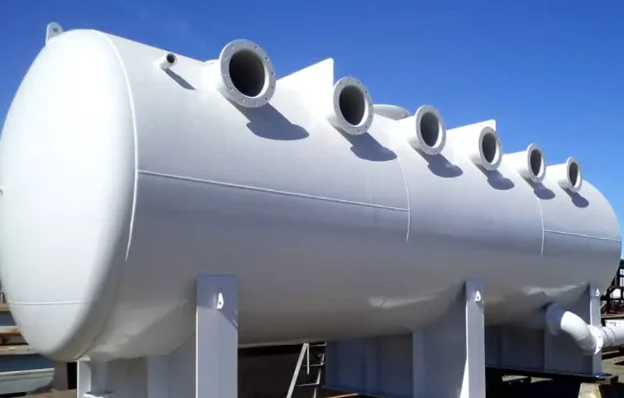
Leveraging 20 years of experience in precision engineering, we have extended our manufacturing excellence to meet the heavy industrial demands of the United Arab Emirates. As premier vacuum receiver tank manufacturers in UAE, Nordstone specializes in custom engineering high-efficiency vacuum liquid collection and storage systems.
Our specialized vacuum receiver tanks are designed to handle demanding industrial processes, managing rapid liquid separation, moisture filtration, and secure containment under extreme negative pressure conditions. Fabricated within our state-of-the-art facilities, each system is optimized for continuous suction operations in sectors ranging from Oil & Gas to specialized process industries.
By maintaining rigorous compliance with global standards, including ASME Section VIII, API, and ISO certifications, Nordstone guarantees structural integrity, zero-deformation risk, and long-term corrosion resistance in the harsh environmental conditions of the UAE. Whether your operations require custom stainless steel configurations or advanced protective internal linings, our engineering team delivers tailored systems that optimize your vacuum utility loops. For specific technical consultations or customized project requirements, contact our engineering team directly via our Contact Us page.
Frequently Asked Questions
1. What is the primary function of a Vacuum Receiver Tank?
A vacuum receiver tank acts as a dedicated buffer and separation containment zone within a vacuum utility network. It accumulates liquids, slurries, and condensates pulled from process lines, preventing these fluids from bypassing downstream and causing catastrophic mechanical failure or fluid carryover into the vacuum pump system.
2. Why should industrial operations in the UAE source Vacuum Receiver Tanks from Nordstone?
Nordstone combines 20 years of experience with deep regional expertise in the UAE’s industrial compliance ecosystem. Our vessels are custom-engineered to withstand heavy cyclical vacuum loads, elevated ambient coastal temperatures, and corrosive environments, ensuring zero-deformation risk and optimal process uptime.
3. Which international design codes do Nordstone vacuum vessels comply with?
All our industrial vessels, including vacuum receiver units, are custom-engineered and fabricated in strict accordance with ASME Section VIII Division 1 standards for pressure and vacuum service, along with relevant API and ISO quality management frameworks.
4. What materials of construction (MOC) are available for your vacuum tanks?
Depending on the chemical composition and temperature profiles of your process media, we fabricate tanks utilizing high-tensile Carbon Steel (with specialized chemical-resistant internal linings), Stainless Steel grade 304/304L, or premium grade 316/316L for maximum corrosion resistance against acidic or saline environments.
5. How does Nordstone prevent vessel implosion under full vacuum conditions?
Implosion prevention relies entirely on structural engineering precision. Our design engineers utilize finite element analysis (FEA) to calculate safe shell thicknesses and incorporate strategic external reinforcement rings (stiffening rings) that allow the vessel to maintain structural integrity under full internal vacuum (-1 bar / 0 Torr).
6. What internal coating options are available for corrosive liquid collection?
To combat corrosive process liquids, we provide specialized internal lining services. This includes sandblasting to SA 2.5 standards followed by the application of multi-layer heavy-duty epoxy, coal tar epoxy, or custom fluoropolymer sheet linings designed to resist chemical degradation.
7. Can your tanks handle multi-phase separation (liquid, gas, and solids)?
Yes. Nordstone custom-configures vacuum receiver tanks with internal baffle plates, demister pads, and specialized inlet deflectors. These design elements reduce velocity upon entry, causing liquid droplets and heavy solids to drop out of suspension while clean gas stream passes through to the vacuum source.
8. What standard capacities and dimensions do you offer in the UAE market?
We do not rely on standard sizes alone. Nordstone specializes in highly customized solutions. We manufacture vessels ranging from small-scale pilot plant receivers (100 liters) to heavy-duty industrial collection tanks exceeding 50,000 liters, tailored to fit the exact spatial layout of your UAE facility.
9. What safety features are integrated into a Nordstone vacuum receiver tank?
Safety is core to our engineering philosophy. Every vessel is built to support critical instrumentation including mechanical vacuum relief valves (VRVs), high-accuracy pressure transmitters, primary and secondary automatic liquid level cut-off switches, and explosion-proof sight glasses for safe visual monitoring.
10. How does the local UAE climate impact vacuum vessel engineering?
The UAE’s high ambient temperatures and humidity levels can accelerate external corrosion and alter gaseous volume metrics inside vacuum lines. We counter this by applying high-performance external marine-grade epoxy coating systems and optimizing total volumetric storage calculation to account for seasonal ambient heat variations.
11. What non-destructive testing (NDT) processes do your tanks undergo?
Before delivery to any site across the UAE, our vessels undergo non-destructive validation. This includes full radiographic testing (RT) of welded seams, ultrasonic testing (UT), magnetic particle inspection (MPI), and rigorous hydrostatic testing or pneumatic pressure holding tests to guarantee leak-free operation.
12. Are your vacuum receiver tanks compatible with hazardous zone environments?
Absolutely. We configure our tanks and matching external instrument packages (such as level sensors and automation switches) to comply fully with ATEX or IECEx specifications required for hazardous zone installations common in the Oil & Gas, chemical processing, and refinery sectors across the UAE.
13. How do I determine the appropriate size of a vacuum receiver tank for my facility?
Sizing depends on your system’s total volumetric flow rate (CFM/m³h), the peak anticipated liquid intake volume, the cycle times of your evacuation pumps, and allowable pressure drops. Our engineering division works directly with your technical team to calculate the ideal surge capacity.
14. What maintenance protocols are recommended to maximize the lifespan of the tank?
Routine maintenance requires periodic inspections of internal linings for signs of erosion or chemical attack, cleaning out accumulated bottom sludge through designated cleanout manways, checking seal integrity on inspection hatches, and recalibrating relief valves and level sensors annually.
15. How can I request a technical quote or engineering drawing from Nordstone?
You can initiate a project review by visiting our official page at Contact Us. Please share your required volume capacity, design temperature, pressure limits, and chemical compositions, and our engineering desk will compile a comprehensive technical proposal.