Nordstone leverages over 20 years of precision engineering experience to deliver high-performance, custom-built modular Energy & Power Skids to developers, utility providers, and industrial facilities across the UAE.
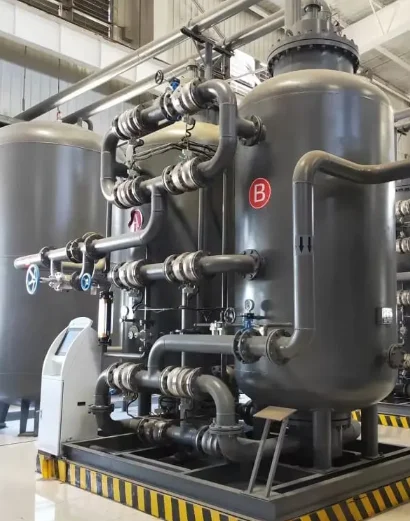
As premier integrated energy systems manufacturers in UAE, our core focus centers on the mechanical design, thermal analysis, and turnkey fabrication of process modular skids capable of enduring extreme pressures, high temperatures, and aggressive corrosive environments.
Fully certified under API, ASME (Section VIII Div. 1 & Div. 2), and ISO protocols, each skid system integrates advanced industrial vessels, precise instrumentation, and robust pipe routing into unified, compact architectures.
From gas treatment and steam regulation to critical fuel conditioning for power generation, our Dubai and Abu Dhabi regional clients depend on Nordstone for field-ready installations that minimize on-site setup times and lower total cost of ownership. Our dedicated in-house engineering team employs specialized design suites—including ASPEN B-JAC, PV Elite, and ANSYS Finite Element Analysis (FEA)—to ensure structural integrity, dynamic safety compliance, and maximum thermodynamic efficiency.
To explore customized configurations or discuss specific operating envelopes with an application specialist, visit our contact page directly.
Frequently Asked Questions (FAQ)
1. What are the core design standards applied to Nordstone energy and power skids?
We manufacture all modular process skids in full compliance with recognized international pressure vessel codes and process piping metrics. Our standard engineering designs conform to ASME Section VIII (Div. 1 & Div. 2) for integrated vessels, ASME B31.3 for process piping networks, and relevant API and NACE (MR0175/MR0103) standards for sour service, alongside stringent ISO quality assurance frameworks.
2. Can Nordstone handle the full mechanical and thermal design of custom skids?
Yes. Backed by 20 years of technical expertise, our team manages the complete design lifecycle in-house. We utilize ASPEN B-JAC and X-Designer for precise thermal calculations, PV Elite or COMPRESS for code-compliant mechanical vessel design, and ANSYS for Finite Element Analysis (FEA) to verify localized nozzle loading and structural steel limits.
3. Which industries in the UAE utilize your integrated power skids?
Our advanced modular skids serve demanding industrial sectors throughout the GCC region, specifically:
- Oil & Gas Refining: Upstream production, fuel conditioning, and gas sweetening.
- Power Generation: Turbine fuel gas regulation, conditioning, and steam loop balance-of-plant.
- Chemical & Petrochemical: Multi-component chemical injection and reaction control.
- Defence & Infrastructure: Critical utility management and localized high-integrity fluid networks.
4. What metallurgical options do you offer for highly corrosive UAE environments?
To resist harsh coastal salinity and H₂S-rich sour processing streams, we fabricate skids utilizing specialized, high-performance alloys. Our material processing capabilities include standard Carbon Steel (SA 516 Gr. 70), Low-Temperature Carbon Steel (LTCS), Austenitic Stainless Steel (SS304/L, SS316/L), Duplex and Super Duplex steels, and high-nickel alloys such as Inconel, Monel, and Hastelloy.
5. Are your manufacturing sites and processes certified for critical power infrastructure?
Yes. Our commitment to equipment reliability is verified by our corporate certifications, which encompass API, ASME (U, U2, R, and S stamps), and international quality management protocols, including ISO 9001, ISO 14001, and ISO 45001.
6. What types of process vessels are typically integrated into your modular energy skids?
Depending on your exact process parameters, we integrate custom-engineered Separator Vessels (two-phase and three-phase designs), Scrubber Vessels / Knock-Out Drums, Flash Drums, Deaerators, Filter Housings, and Shell & Tube Heat Exchangers designed to optimize thermodynamic performance.
7. Do you perform Computational Fluid Dynamics (CFD) analysis for skid internals?
Yes. For complex systems like three-phase separators or high-velocity gas conditioning skids, we conduct multi-phase CFD Analysis. This allows us to optimize internal flow distribution, prevent channeling, verify the placement of vane packs or mist eliminators, and ensure predictable performance before the fabrication phase begins.
8. What quality control testing is conducted prior to skid delivery?
Every process module undergoes an intensive Quality Assurance/Quality Control (QA/QC) validation protocol. This includes Non-Destructive Testing (NDT) such as Radiographic Testing (RT), Ultrasonic Testing (UT), Magnetic Particle Inspection (MPI), and Dye Penetrant Testing (DPT), followed by formal hydrostatic or pneumatic pressure testing and comprehensive material traceability verification.
9. What are the operational limits for your high-pressure power skids?
Because every system is custom-engineered, we can scale our structural designs to handle extremely severe service envelopes. Our modular systems are regularly rated for design pressures spanning from full vacuum up to 200 bar, with design temperatures engineered to withstand ranges from -50°C up to +400°C.
10. How do modular, factory-built skids compare to traditional on-site stick-built systems?
Factory-assembled modular skids offer significant advantages over site-built configurations:
- Controlled Assembly: All welding, pipe fitting, and structural integration occur within a pristine, ISO-monitored facility.
- Minimized Site Disruption: civil work at your UAE facility can proceed concurrently with skid fabrication, cutting overall project timelines.
- Reduced Labor Risks: Minimal hot work and field testing are required on-site, decreasing safety liabilities.
11. Can Nordstone incorporate specialized automated control systems into the skid frame?
Yes. We supply fully integrated automation packages. Skids can be pre-wired with localized junction boxes, Programmable Logic Controllers (PLCs), safety instrumented systems (SIS), flow control valves, and diagnostic sensors that communicate seamlessly with your main facility’s Distributed Control System (DCS) via standard industrial protocols.
12. Do you provide defensive or structural protective coatings for offshore deployment?
Yes. For marine, near-shore, or harsh desert environments, we offer high-durability industrial coating systems. Options include multi-coat epoxy systems, glass-flake linings for interior vessel protection, phenolic coatings, and specialized passive fireproofing treatments certified to withstand prolonged environmental exposure.
13. How does Nordstone manage material traceabilities and project documentation?
We maintain complete material transparency. Every delivered energy system includes a comprehensive manufacturing data report containing certified Material Test Reports (MTRs) for all pressure-retaining components, custom Welding Procedure Specifications (WPS), Procedure Qualification Records (PQR), Welder Performance Qualifications (WPQ), and certified NDE validation records.
14. What are the typical lead times for a custom energy skid?
Lead times vary depending on the mechanical scope, material availability (such as specialized alloys), and instrumentation complexity. Because our advanced production facilities span 30,000 square meters and feature automated fabrication systems, we are structurally optimized to deliver compressed schedules compared to industry averages. Please contact our technical sales team for an accurate project estimate.
15. How do I request an engineering proposal or technical consultation from Nordstone?
You can initiate a detailed request for quotation by submitting your process parameters, data sheets, and spatial constraints directly to our engineering division via our secured contact portal. Our technical team will review your specifications to deliver a comprehensive mechanical and commercial proposal.