Decades of Engineering Excellence: High-Performance Thermal Solutions
As a trusted leader in precision engineering with over 20 years of experience, Nordstone specializes in designing and manufacturing high-efficiency spiral heat exchangers tailored for the UAE’s demanding industrial sectors.
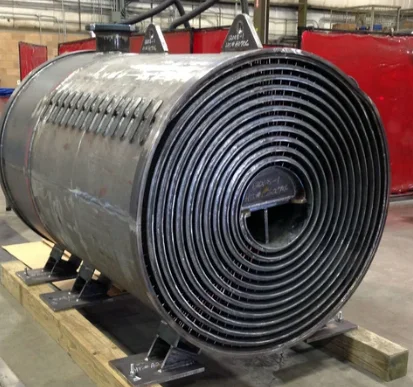
In critical applications across Dubai, Abu Dhabi, and the wider GCC region, traditional shell and tube exchangers often struggle with fouling and spatial constraints. Our state-of-the-art manufacturing facility engineers custom spiral heat exchangers that excel in handling high-viscosity fluids, heavy fouling slurries, and extreme thermal conditions.
By utilizing a single-channel concentric design, these compact thermal systems induce high turbulence, creating a self-cleaning mechanism that drastically reduces maintenance downtime and lifecycle costs. Whether your operations are in Oil & Gas, petrochemical processing, wastewater treatment, or heavy manufacturing, Nordstone delivers robust thermal solutions certified to international standards, including API, ASME, and ISO.
We ensure every unit provides maximum heat transfer coefficients while maintaining a remarkably compact footprint.
Partner with the UAE’s premier thermal equipment manufacturers to optimize your plant’s energy efficiency. To discuss your project’s specific thermal and mechanical requirements with our expert engineering team, contact our UAE specialists today.
Frequently Asked Questions (FAQ)
Here are the top 15 highly relevant, technical, and commercial FAQs optimized for UAE industrial procurement teams and plant managers:
1. What is a spiral heat exchanger, and how does it work?
A spiral heat exchanger consists of two long metal plates wrapped around a central core to form two concentric, concentric channels. Fluids flow in counter-current directions within these single channels. This curved pathway induces continuous centrifugal force and high fluid turbulence, maximizing heat transfer efficiency even at low velocities.
2. Why should industrial plants in the UAE choose spiral heat exchangers over shell and tube models?
Spiral heat exchangers offer a significantly more compact footprint (requiring up to 60% less space) and are highly resistant to fouling. In the UAE’s harsh environments, their single-channel design prevents the dead zones where scaling and sediment build-up typically occur in shell and tube bundles.
3. Which industries in the UAE benefit most from Nordstone’s spiral heat exchangers?
Our thermal solutions are widely deployed in Oil & Gas processing, petrochemical plants, desalination facilities, heavy wastewater treatment, and chemical manufacturing across Abu Dhabi and Dubai. They are ideal for handling sludge, hydrocarbons, and fibrous fluids.
4. Can Nordstone’s spiral heat exchangers handle corrosive fluids like seawater or sour gas?
Yes. We manufacture units using high-grade, corrosion-resistant alloys, including Duplex stainless steel, Super Duplex, Titanium, and Hastelloy, which are specifically chosen to withstand the UAE’s aggressive marine and sour gas environments.
5. What design and manufacturing certifications does Nordstone hold?
Upholding our 20-year track record of engineering triumphs, our manufacturing processes, pressure vessels, and thermal systems are fully certified under ASME Section VIII Div. 1, API 660, and ISO 9001:2015 standards.
6. What is the “self-cleaning mechanism” in a spiral heat exchanger?
Because it features a single channel for each fluid, any localized fouling or deposit buildup narrows the channel width. This constriction forces fluid velocity to increase immediately at that exact spot, naturally flushing away the deposit.
7. What are the maximum temperature and pressure limits for these units?
While spiral heat exchangers are primarily celebrated for low-to-medium pressure applications, Nordstone custom-engineers heavy-duty units capable of handling operating pressures up to 35-40 bar and temperatures exceeding 400°C, depending on the specific mechanical design.
8. How does a compact design impact energy efficiency and operating costs?
The high heat transfer coefficients mean you achieve identical or superior thermal performance in a fraction of the physical size. This reduces initial structural footprint costs, piping requirements, and overall energy consumption, delivering a rapid ROI for GCC operators.
9. Do you provide custom-engineered thermal solutions for existing plant retrofits?
Absolutely. Our expert engineering team utilizes advanced thermal rating software to design custom dimensions, nozzle configurations, and mounting systems that seamlessly integrate into your existing facility footprints without costly piping re-routing.
10. How does Nordstone ensure quality control during the manufacturing process?
From material receipt to final hydrostatic testing, our rigorous quality control includes non-destructive testing (NDT), such as radiographic, ultrasonic, and dye-penetrant testing, ensuring flawless welds and absolute pressure containment.
11. Can these heat exchangers handle fluids with high solid particle content?
Yes, this is their primary advantage. The single-channel design allows particles and slurries to pass through easily without clogging, unlike multi-pass or plate-and-frame alternatives that trap debris.
12. What are the typical maintenance requirements for a spiral heat exchanger?
Maintenance is exceptionally low due to the self-cleaning design. When cleaning is required, the hinged or bolted covers can be easily removed to expose the entire heat transfer surface for quick mechanical washing or chemical cleaning (CIP).
13. How does the UAE’s ambient climate affect the thermal design of these units?
Our engineers specifically account for high ambient air temperatures and solar radiation factors unique to the Middle East, ensuring the log mean temperature difference (LMTD) calculations guarantee peak performance during summer extremes.
14. What lead times can we expect for manufacturing in the UAE?
Lead times depend entirely on material selection (e.g., standard stainless steel vs. exotic titanium alloys) and design complexity. Because we manufacture locally with a robust regional supply chain, we offer highly competitive turnaround times compared to international importers.
15. How can we request a technical consultation or quote for our project?
You can easily reach out to our technical sales and engineering division by visiting our dedicated communication page at Contact Us to share your process flow data sheets (PFDs) and mechanical requirements.