As the United Arab Emirates rapidly expands its clean energy infrastructure and bunkering footprint, Nordstone delivers world-class engineering to meet the region’s evolving energy needs.
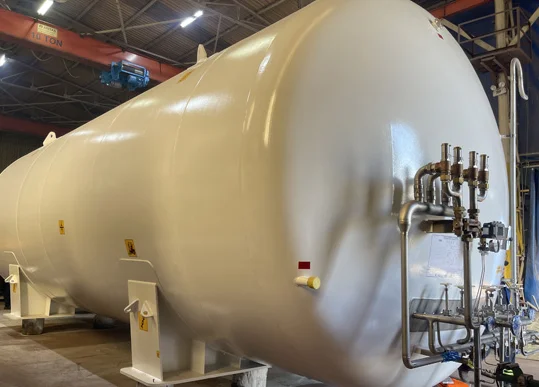
Backed by 20 years of experience, we have positioned ourselves as premier LNG Storage Vessel – Liquefied Natural Gas Storage Solutions manufacturers in UAE, engineering high-performance containment systems that withstand the absolute extremes of cryogenic operations. Operating out of our state-of-the-art manufacturing facility, our expert team provides tailor-made, double-walled vacuum-insulated vessels designed to keep liquefied natural gas stable at critical temperatures reaching down to -162°C.
From Jebel Ali to Das Island, our industrial vessels are optimized for zero-boil-off performance, maximum structural integrity, and strict adherence to localized safety frameworks like the Abu Dhabi Occupational Safety and Health Center (OSHAD) codes and international marine terminal protocols.
The Cryogenic Benchmark: Every LNG storage solution engineered by Nordstone is precision-fabricated with high-nickel alloys and premium austenitic stainless steel internal tanks. This material choice completely mitigates low-temperature thermal stress, guaranteeing robust safety margins and flawless asset performance over decades of field service.
Our custom engineering capabilities span the entire industrial lifecycle—covering terminal bulk storage, localized peak-shaving facilities, and ruggedized marine bunkering applications across the Middle East. Because we recognize that handling volatile cryogenic fluids leaves absolutely zero room for error, every Nordstone storage asset is backed by strict ASME Section VIII, API 620 (Appendix Q), and ISO certifications. This strict alignment with international quality standards ensures total traceabilty and structural reliability under extreme pressures. Do you require custom thermal analysis, finite element analysis (FEA) design, or an optimized technical blueprint for your next industrial project?
Connect with our expert engineering team directly through our official channels.
Frequently Asked Questions
1. What design codes and international standards do Nordstone LNG storage vessels adhere to?
Our vessels are manufactured in complete compliance with ASME Section VIII (Divisions 1 & 2) for pressure vessels and API 620 (specifically Appendix Q), which governs the design and construction of large, welded, low-temperature liquefied gas storage tanks. We also integrate ISO 9001 quality management guidelines to ensure every asset satisfies global energy sector procurement requirements.
2. How does Nordstone control Boil-Off Gas (BOG) in the harsh UAE climate?
We employ a specialized double-wall configuration featuring a high-vacuum annular space filled with premium insulation materials like expanded perlite or multi-layer insulation (MLI). This specialized thermal barrier minimizes heat leakages, keeping the inner container at its required temperature even when ambient temperatures in the UAE exceed 50°C.
3. Which materials are utilized to withstand extreme cryogenic temperatures?
The inner vessel, which directly holds the LNG at -162°C (-260°F), is built using premium 9% nickel alloy steel or austenitic stainless steel (such as Grade 304 or 316). These materials are chosen because they retain excellent impact toughness and resist brittle fractures at sub-zero temperatures, unlike standard carbon steels.
4. What types of LNG storage configurations can you manufacture?
We specialize in engineering bullet-type horizontal pressure vessels (Type C bi-lobe or cylindrical tanks), vertical storage setups, and can design components for full-containment or double-containment atmospheric storage tanks depending on the volume footprint your project requires.
5. Does Nordstone provide customized engineering for specific industrial footprints?
Yes. Our engineering team utilizes advanced Finite Element Analysis (FEA) and Computational Fluid Dynamics (CFD) software to customize vessel capacities, pressure thresholds, nozzle orientations, and piping layouts according to your site’s physical and operational constraints.
6. Are your manufacturing processes certified for critical oil & gas applications?
Yes, our 20 years of manufacturing experience are backed by official ASME (U, U2, and R stamps), API, and ISO certifications. These qualifications validate our technical capacity to deliver heavy industrial vessels to high-risk environments like defense installations, refineries, and offshore platforms.
7. How are the welds tested on a cryogenic vessel?
We execute a rigorous, non-destructive testing (NDT) protocol. This includes 100% Radiographic Testing (RT) on all primary pressure-retaining butt welds, Ultrasonic Testing (UT), Magnetic Particle Testing (MT), and high-sensitivity Helium Leak Detection to confirm vacuum integrity before shipping.
8. What is the typical operational lifespan of a Nordstone LNG storage vessel?
With correct installation and regular maintenance, our industrial pressure vessels are engineered for an operational lifespan exceeding 30 to 40 years. The combination of high-grade corrosion-resistant alloys and robust structural safety factors ensures long-term asset reliability.
9. Can your storage solutions support marine LNG bunkering applications?
Absolutely. We customize Type C cryogenic tanks specifically tailored for marine bunkering terminals and vessel fuel systems. These designs account for dynamic sloshing loads, maritime space limitations, and international marine safety regulations (such as the IGF Code).
10. How do you protect the external vessel wall from the UAE’s highly corrosive coastal environments?
The outer shell (carbon steel vacuum jacket) is treated with a heavy-duty, marine-grade protective coating system. This involves multi-coat epoxy primers and polyurethane topcoats engineered to resist high humidity, UV exposure, and salt-spray corrosion typical of UAE maritime zones.
11. What safety and overpressure relief systems are included with your vessels?
Every vessel is outfitted with dual redundant safety relief valves (SRVs) via a three-way changeover valve, vacuum-jacket burst discs, continuous pressure-monitoring transmitters, and automated emergency shutdown valve (ESD) interfaces to prevent vacuum loss or dangerous overpressure states.
12. Do you cater to fast-tracked energy infrastructure projects within the GCC region?
Yes. With our advanced manufacturing facility and structured inventory tracking, we optimize production scheduling to deliver critical pressure vessels within competitive timeframes without compromising on safety or engineering checks.
13. Is material traceability available for client audits?
Yes. We maintain comprehensive Material Test Reports (MTRs) and provide complete traceability documentation for every sheet of steel, nozzle, forging, and welding consumable utilized during fabrication, ensuring absolute compliance with EEAT principles.
14. What are the key differences between API 620 and ASME Section VIII for LNG?
API 620 Appendix Q is primarily applied to field-erected, large-scale, low-pressure flat-bottom tanks operating at pressures under 15 PSI. ASME Section VIII is the industry benchmark for shop-fabricated, higher-pressure cylindrical vessels (bullet tanks) that require higher structural flexibility.
www.littlepeng.com
15. How can we initiate a technical consultation or receive a custom quotation?
You can submit your technical specifications, thermal design targets, and volume metrics directly to our engineering coordinators. Please visit our dedicated Contact Us page to initiate an inquiry, and our technical sales team will assist you with a comprehensive proposal.