As a leading degasser vessel manufacturer in UAE, Nordstone delivers high-performance, precision-engineered gas separation systems tailored for critical oil, gas, and industrial applications across the Middle East. With over 20 years of manufacturing excellence, our state-of-the-art facility designs and fabricates custom vacuum and atmospheric degasser vessels built to withstand extreme pressures, high temperatures, and highly corrosive environments.
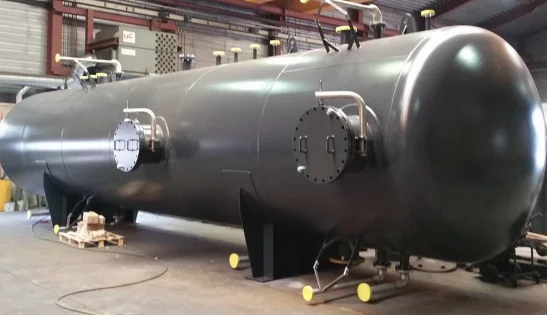
Nordstone’s engineering team specializes in producing robust production separators and drilling fluid degassers that ensure optimal phase separation and downstream equipment protection. Certified to stringent global standards including ASME, API, and ISO, we uphold unwavering quality control from initial design to final pressure testing. Whether you require standard mud degassers for drilling operations or complex automated separation units for downstream refining, Nordstone provides regional energy leaders with unmatched reliability, safety, and operational efficiency.
Need a custom engineering consultation? Connect with our technical team today at our Contact Us page to discuss your project’s specific design codes, flow rates, and material requirements.
Frequently Asked Questions (FAQs)
1. What types of degasser vessels does Nordstone manufacture in the UAE?
Nordstone designs and manufactures a comprehensive range of degasser vessels, including atmospheric degassers, vacuum degassers, and specialized mud-gas separators (poor boy degassers) used extensively in upstream drilling, midstream processing, and downstream refining across the UAE.
2. Which design codes and international standards do your vessels comply with?
All our degasser vessels are engineered and fabricated in strict accordance with international pressure vessel codes, primarily ASME Section VIII Division 1 & 2, API 12J, and ISO 9001:2015 quality management systems.
3. What materials of construction (MOC) do you use for corrosive environments in the Middle East?
To combat sour gas (H2S) and high-chloride environments typical in UAE oilfields, we utilize high-grade carbon steel with NACE MR0175/ISO 15156 compliance, stainless steel (316/316L), duplex, and super duplex stainless steels, as well as specialized internal corrosion-resistant alloy (CRA) claddings.
4. Can Nordstone provide custom-engineered degasser vessels?
Yes. Our in-house team of expert engineers specializes in custom solutions. We tailor the vessel’s dimensions, nozzle configurations, internal baffling, mist extractors, and instrumentation brackets to match your exact flow rates, operating pressures, and space constraints.
5. What is the typical lead time for manufacturing a degasser vessel in the UAE?
Lead times vary depending on the vessel’s complexity, size, and material availability (e.g., standard carbon steel vs. exotic alloys). Typically, a custom ASME-certified degasser vessel takes between 12 to 22 weeks from finalized engineering drawings to delivery.
6. Do you supply fully automated degasser skid packages?
Yes, we offer completely integrated, turn-key degasser skid packages. These include the pressure vessel, structural steel skid, piping, valves, level controllers, pressure transmitters, and control panels (PLC-based) for seamless “plug-and-play” site installation.
7. What non-destructive testing (NDT) and quality control measures do you perform?
Our rigorous quality control framework includes 100% radiography testing (RT) on critical welds, ultrasonic testing (UT), magnetic particle testing (MT), dye penetrant testing (PT), and hydrostatic pressure testing witnessed by third-party inspection (TPI) agencies.
8. Are Nordstone degasser vessels approved by major UAE national oil companies?
Nordstone operates to the strict pre-qualification baselines required by major regional operators like ADNOC and their Tier-1 EPC contractors, ensuring our documentation, safety track record, and fabrication quality meet national threshold standards.
9. How do your vacuum degassers handle high-viscosity drilling fluids?
Our vacuum degassers utilize optimized internal corrugated plates or leaf designs that spread the mud into thin layers. This maximizes the surface area, allowing trapped gas bubbles to break free easily under vacuum pressure, even in highly viscous or weighted drilling muds.
10. What internal components are used to optimize gas separation?
Depending on the application, we integrate advanced internals such as inlet deflectors, vane pack mist extractors, wire mesh demisters, wave breakers, and calming baffles to prevent liquid carryover and maximize gas separation efficiency.
11. Do you offer field installation, commissioning, or aftermarket support in the UAE?
Yes, Nordstone provides comprehensive site support across the UAE. Our field engineers assist with site installation oversight, mechanical completion checks, pre-commissioning, commissioning, and regular maintenance or spare parts supply.
12. How does Nordstone ensure the vessel can handle sour gas (H2S) applications?
For sour service, we strictly adhere to NACE MR0175/ISO 15156 guidelines. This involves using Post-Weld Heat Treatment (PWHT), utilizing HIC (Hydrogen-Induced Cracking) resistant steels, and conducting rigorous hardness testing on all weld zones to prevent sulfide stress cracking.
13. What maximum operating pressures and temperatures can your vessels accommodate?
Because we specialize in critical applications, our manufacturing capabilities cover low-pressure atmospheric systems up to high-pressure separation units exceeding 100 bar (1450 psi) and temperatures ranging from cryogenic levels up to +250∘C.
14. How can I request a technical quote or submit an RFQ to Nordstone?
You can easily submit your data sheets, piping and instrumentation diagrams (P&IDs), and project specifications directly through our dedicated portal at Contact Us. Our estimation team will review and respond with a technical proposal.
15. Why should we choose a UAE-based manufacturer like Nordstone over overseas suppliers?
Choosing Nordstone ensures significantly lower freight costs, zero import delays, faster site delivery, and compliance with local In-Country Value (ICV) metrics. Crucially, it gives your engineering teams direct access to our facility for physical inspection, design reviews, and prompt local aftermarket engineering support.