As the United Arab Emirates continues to accelerate its industrial and manufacturing capabilities, optimizing thermal performance in harsh desert conditions has become a core operational priority.
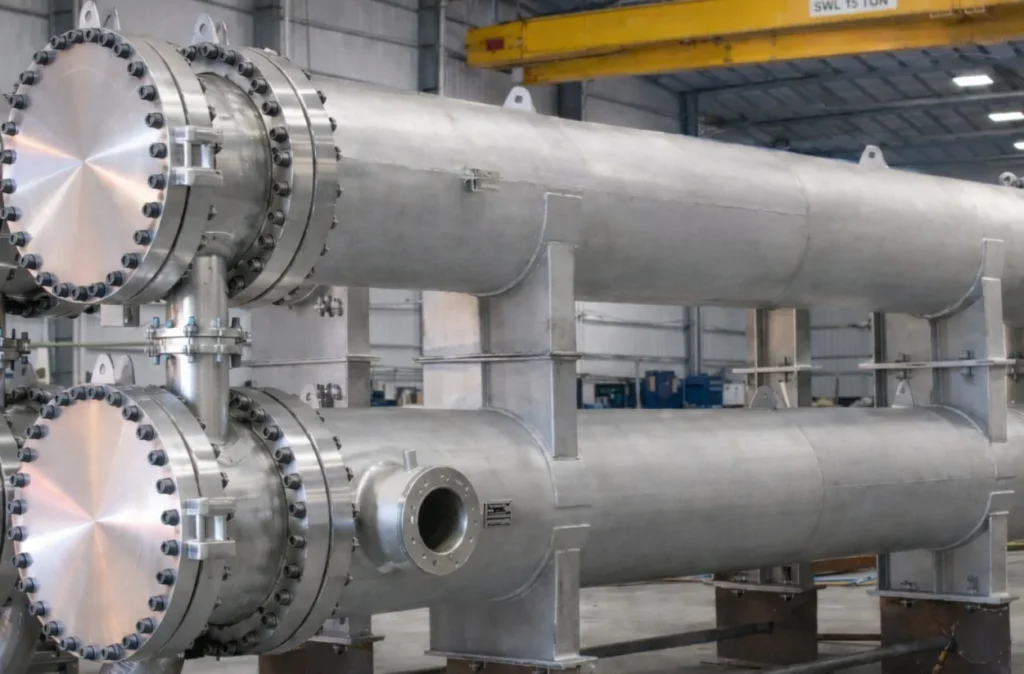
Nordstone stands at the forefront of this evolution, leveraging 20 years of experience and over three decades of engineering excellence to design and manufacture premium, high-performance specialty heat exchangers.
Our advanced thermal management systems are explicitly engineered to withstand the extreme temperatures, pressures, and highly corrosive environments typical of the Gulf region. By integrating cutting-edge thermodynamic designs with precision fabrication, we empower critical sectors across Abu Dhabi, Dubai, and the Northern Emirates to maximize heat recovery, drastically reduce energy consumption, and maintain operational stability.
EEAT Core Value: Every custom thermal solution built at our state-of-the-art facilities undergoes meticulous quality control from start to finish. Our structural integrity and fluid dynamics models are backed by strict adherence to international safety benchmarks, holding fully accredited API, ASME (U & R Stamps), and ISO certifications to ensure absolute reliability for your critical infrastructure.
Tailored Thermal Infrastructure for the Middle East
Our specialized heat transfer division supports heavy industry through customized manufacturing configurations:
- Custom Metallurgy: Utilization of Duplex steel, Titanium, and Super Alloys to combat localized marine and chemical corrosion.
- High-Pressure Reliability: Systems rated for extreme processing environments spanning Oil & Gas, Petrochemicals, and Defence applications.
- Maximum Heat Recovery: Advanced geometric surface modifications designed to optimize thermal efficiency and decrease operating costs.
If you are looking to audit, upgrade, or custom-engineer your industrial thermal infrastructure to meet modern efficiency benchmarks, our engineering team is ready to map out your technical specifications.
To discuss your facility’s custom pressure, temperature, and material requirements with our technical sales division, visit our Contact Us page.
Frequently Asked Questions (FAQ)
1. What are specialty heat exchangers, and how do they differ from standard thermal units?
Specialty heat exchangers are custom-engineered thermal management systems designed for processing conditions where standard off-the-shelf units fail. They feature specialized internal geometries, advanced materials (such as titanium, super duplex, or hastelloy), and distinct sealing technologies. Unlike standard configurations, they are built to handle highly corrosive fluids, extreme high-temperature streams, or volatile pressure drops without suffering thermal stress or mechanical degradation.
2. Why should industrial facilities in the UAE prioritize custom-engineered specialty heat exchangers?
The UAE’s industrial sector operates under intense environmental pressures, including high ambient coastal temperatures, elevated humidity, and highly saline or corrosive atmospheres. Standard systems frequently suffer from rapid fouling, accelerated pitting corrosion, and reduced thermal efficiency. Custom-engineered units from Nordstone are explicitly modeled to counter these environmental conditions, preserving continuous uptime and reducing costly field repairs.
3. Which industrial sectors in the UAE benefit most from Nordstone’s advanced thermal solutions?
Our certified heat transfer equipment provides critical support to a wide array of demanding regional sectors, including:
- Oil & Gas (Upstream and Downstream): Refining, gas sweetening, and offshore platform processing. nordstonein.com
- Chemical & Petrochemical Processing: Handling aggressive chemical compounds and high-temperature cracking loops.
- Power Generation & Desalination: Maximizing steam condensation and process heat recovery loops.
- Defence & Heavy Manufacturing: Providing robust climate and process cooling sub-systems under extreme duress.
4. How does Nordstone optimize heat exchangers for high-pressure and high-temperature environments?
We utilize advanced finite element analysis (FEA) and computational fluid dynamics (CFD) modeling to simulate exact thermal stresses and fluid velocities before fabrication begins. Combined with our heavy-wall manufacturing capabilities, precise welding automation, and robust mechanical designs, our specialty systems maintain structural integrity under severe cyclic thermal loading and extreme operational pressures.
5. What specific international certifications do Nordstone heat exchangers carry?
To guarantee safety and international compliance within hazardous environments, our manufacturing processes are audited and certified under globally recognized frameworks. This includes the American Society of Mechanical Engineers (ASME Section VIII, Div 1 & 2 with U and R stamps), American Petroleum Institute (API standards), and strict ISO 9001:2015 quality management protocols.
6. What types of specialized configurations does Nordstone manufacture in the UAE?
Our comprehensive engineering footprint enables the design and production of multiple specialized categories:
- Shell & Tube Heat Exchangers (High-pressure, custom header designs) nordstonein.com
- Air-Cooled Heat Exchangers (ACHE optimized for ambient desert environments) nordstonein.com
- Plate & Shell and Spiral Heat Exchangers (For highly viscous or particle-heavy fluids) nordstonein.com
- Custom Condensers, Reboilers, and Evaporators nordstonein.com
7. How do your specialty designs improve industrial energy efficiency?
By engineering customized fluid flow paths and utilizing extended heat-transfer surfaces (such as advanced finned tubes or micro-channel matrices), we minimize thermal resistance and pressure drop. This increases the total amount of energy recovered from waste streams, instantly reducing fuel consumption for boilers or fired heaters and shrinking your facility’s carbon footprint.
8. How does material selection help resist corrosion in Gulf marine environments?
Standard carbon steels degrade rapidly when exposed to brackish or high-salinity cooling water. Nordstone utilizes high-alloy materials specifically chosen for their localized corrosion resistance. Depending on the chemical footprint of your process, we engineer components out of Stainless Steel (316L), Duplex and Super Duplex steels, Nickel alloys, or Grade 2 Titanium to eliminate stress-corrosion cracking and pitting.
9. What is fouling, and how do your specialty units mitigate its impact?
Fouling is the unwanted accumulation of deposits (scale, biological growth, or chemical precipitates) along the heat transfer walls, which chokes fluid flow and insulates thermal exchange. We combat fouling through targeted hydraulic designs that maintain high wall shear stress, applying anti-fouling surface treatments, and arranging internal geometries to allow simple, non-destructive mechanical or chemical cleaning access.
10. Can Nordstone manufacture direct replacements for existing or legacy heat exchangers?
Yes. Our engineering division excels at thermal and mechanical reverse engineering. If you have an outdated, inefficient, or failing unit from a legacy manufacturer, we can analyze the operating parameters, upgrade the material specification to meet modern durability standards, and fabricate a drop-in replacement that aligns perfectly with your existing plant footprint and piping layout.
11. What quality control steps are taken during the manufacturing process?
Every vessel and heat exchanger built at our facilities undergoes a multi-point quality control regimen. This includes non-destructive testing (NDT) methods such as radiographic examination (X-ray), ultrasonic testing, liquid penetrant testing, magnetic particle verification, and mandatory high-pressure hydrostatic testing to ensure zero-leak performance under field pressures.
12. How does an Air-Cooled Heat Exchanger (ACHE) perform effectively in the hot UAE summer?
Standard air coolers can struggle when ambient temperatures exceed 45°C. Nordstone addresses this challenge by engineering high-efficiency variable-frequency drive (VFD) fan systems, optimizing fin-tube spacing to boost air turbulence, and enlarging the available thermal surface area. This ensures predictable process fluid cooling even during peak Middle Eastern summer conditions.
13. What support services do you offer after a heat exchanger is delivered?
Our commitment to your operations extends well past product delivery. We provide technical advisory services for field installation, pre-commissioning asset checks, startup balancing, and long-term lifecycle maintenance support. This includes providing detailed operations manuals and specifying recommended replacement gasket and seal kits to minimize future turnaround times.
14. What are the lead times for custom-engineered heat transfer equipment in the UAE?
Lead times vary depending on structural complexity, scale, and the specific metallurgy required for your project. Because we maintain an agile, vertically integrated supply chain and local manufacturing hubs, we optimize raw material procurement to offer some of the most competitive engineering and fabrication timelines available in the GCC region.
15. How do I request a technical proposal or thermodynamic quote for my facility?
To start a project configuration, navigate to our dedicated communications portal by using our Contact Us link. Provide your primary process data sheet details—such as design pressures, hot and cold fluid compositions, target thermal loads, and material requirements—and our specialist application engineers will compile a comprehensive mechanical and thermal proposal tailored to your parameters.