As a leading industrial heavy-equipment authority with 20 years of experience, Nordstone designs, engineers, and manufactures high-performance Deaerator (DA Vessel) systems tailored for the demanding thermal power, petrochemical, and manufacturing sectors across the UAE.
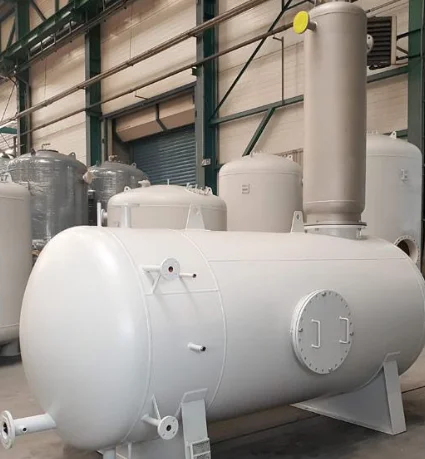
Operating from our state-of-the-art manufacturing facility, our expert engineering teams construct custom boiler and steam pressure vessels that endure extreme pressures, thermal cycling, and corrosive environments. By removing dissolved gases like oxygen ($O_2$) and carbon dioxide ($CO_2$) from boiler feedwater down to critical parts-per-billion (ppb) thresholds, a Nordstone DA vessel significantly eliminates internal pitting, scaling, and premature failure across your entire steam generation infrastructure.
Every custom unit we produce is fully compliant with ASME Section VIII (Div. 1 & 2), API, and ISO quality frameworks, guaranteeing exceptional structural reliability, maximized plant thermal efficiency, and complete structural safety in the most demanding industrial operations.
Industrial Spec Sheet: Nordstone DA Vessels
- Design Standard Compliance: ASME Section VIII Div. 1 & 2, IBR, PED 2014/68/EU
- Material Specialization: Carbon Steel (SA 516 Gr. 70), Stainless Steel (SS316L, SS304L), and Exotic Anti-Corrosive Cladding
- Primary Function: Mechanical removal of dissolved $O_2$ (down to less than 7 ppb) and free $CO_2$ from steam boiler feed water
- Operational Environments: Custom-engineered to withstand rapid thermal shock, extreme pressure fluctuations, and highly corrosive chemical dosing environments
To discuss your industrial steam infrastructure layout, material requirements, or custom configurations, reach out directly to our technical engineering division via our dedicated link at Contact Us.
Frequently Asked Questions (FAQs)
1. What is a Deaerator (DA Vessel) and what is its primary function?
A Deaerator (DA Vessel) is a specialized mechanical pressure vessel designed to remove dissolved gases—primarily oxygen (O2) and carbon dioxide (CO2)—from boiler feedwater. Its main function is to protect the boiler tubes, steam lines, and heat exchangers from rapid internal corrosion, which can cause catastrophic wall thinning and leaks.
2. Why are Nordstone Deaerators essential for UAE industrial plants?
In the UAE, industrial water systems are heavily reliant on desalinated or treated water, which carries distinct thermal and chemical profiles. A Nordstone DA vessel optimizes the water treatment cycle, lowering chemical scavenging costs, safeguarding capital-intensive boiler machinery, and ensuring high uptime for continuous-duty industrial plants.
3. What are the two main types of DA Vessels manufactured by Nordstone?
We design and manufacture both major industrial configurations:
- Tray-Type Deaerators: Features a vertical domed deaeration column filled with internal trays mounted above a horizontal storage vessel. Water cascades down the trays, maximizing surface contact with rising steam.
- Spray-Type Deaerators: Employs a single horizontal or vertical configuration utilizing high-efficiency spray nozzles to atomize incoming feed water into a steam-rich atmosphere for rapid gas extraction.
4. What code certifications apply to Nordstone boiler and steam pressure vessels?
All Nordstone industrial vessels are designed, engineered, and certified under strict international protocols. This includes ASME Section VIII Division 1 & Division 2 (U and R Stamps), along with ISO 9001, ISO 14001, and ISO 45001 quality, environmental, and safety management frameworks.
5. To what level can a Nordstone DA Vessel reduce dissolved oxygen?
Our custom mechanical deaeration systems are engineered to reduce dissolved oxygen (O2) concentrations in boiler feedwater down to less than 7 parts per billion (ppb) or 0.005 mg/L. This dramatically cuts down on the amount of chemical oxygen scavengers (like hydrazine or sodium sulfite) required in subsequent treatment steps.
6. How does a Deaerator prevent carbon dioxide (CO2) corrosion?
Dissolved carbon dioxide combines with water to form highly aggressive carbonic acid (H2CO3), which drops the pH level and corrodes copper and steel steam-side components. By heating the water to saturation temperature, the DA vessel releases this gas through a dedicated vent before it ever reaches the boiler.
7. What types of raw materials does Nordstone use for DA Vessel construction?
Depending on your pressure, temperature, and fluid chemical profiles, we fabricate vessels using heavy-duty ASME-grade Carbon Steel (such as SA 516 Gr. 60/70) for outer shells. Internal high-wear components, trays, and spray nozzles are standardly configured from corrosion-resistant Stainless Steel (SS304L, SS316L) or specialized alloys.
8. Can Nordstone build custom skid-mounted Deaerator systems?
Yes. We specialize in fully integrated, modular process skids. A skid-mounted Nordstone DA package comes complete with the storage tank, deaerating column, structural steel support framework, access platforms, interconnected piping, feed pumps, and pre-wired instrumentation control panels for fast site installation.
nordstoneng.com
9. What operational pressures and temperatures can your steam vessels handle?
Our heavy-duty pressure vessels can be custom-engineered to operate from low-pressure utility ranges up to high-pressure industrial power generation thresholds. Standard operating ranges typically sit anywhere from 0.5 bar up to 200 bar and handle process temperatures spanning from –50°C to +400°C.
10. What is the difference between a Deaerator and a standard feed water tank?
A standard feed water tank acts solely as an atmospheric storage reservoir to accumulate condensate and makeup water. A Deaerator is a sealed, ASME-certified pressure vessel specifically designed with thermal and mechanical internals to actively boil, scrub, separate, and vent non-condensable gases from the liquid stream.
11. What kind of internal flow optimization does Nordstone utilize?
We employ advanced Computational Fluid Dynamics (CFD) modeling during the engineering phase. This allows us to analyze residence time, eliminate internal dead zones, balance thermal distribution, and incorporate anti-vortex features to ensure seamless vapor-liquid separation under shifting steam demands.
12. Does Nordstone offer non-destructive testing (NDT) for pressure vessels?
Absolutely. Quality control is managed thoroughly from start to finish. Our in-house testing procedures include 100% Radiography Testing (RT) for structural welds, Ultrasonic Testing (UT), Magnetic Particle Testing (MPT), Dye Penetrant Testing (DPT), and full hydrostatic/pneumatic pressure tests before shipping.
13. Which industrial sectors in the Middle East do you serve?
With over 20 years of expertise, our high-performance industrial vessels are widely deployed across critical infrastructure sectors including Oil & Gas refineries, Petrochemical processing complexes, Power Generation plants, Fertilizers, heavy manufacturing, and Defence installations.
14. How does a DA vessel contribute to plant energy conservation?
A Deaerator utilizes low-pressure exhaust steam or flash steam from other plant processes to preheat the boiler feed water (often up to 100°C or higher). By returning this thermal energy directly back into the feed water line, it reduces the thermal shock on the boiler and drops overall fuel consumption.
15. How do I request a custom quotation or technical consultation?
You can get in touch with our specialized engineering, estimation, and design teams by visiting our office portal at Contact Us. Provide us with your design pressure, volumetric flow rates, spatial footprint constraints, and preferred material grades, and we will tailor an efficient industrial solution to match your exact production goals.