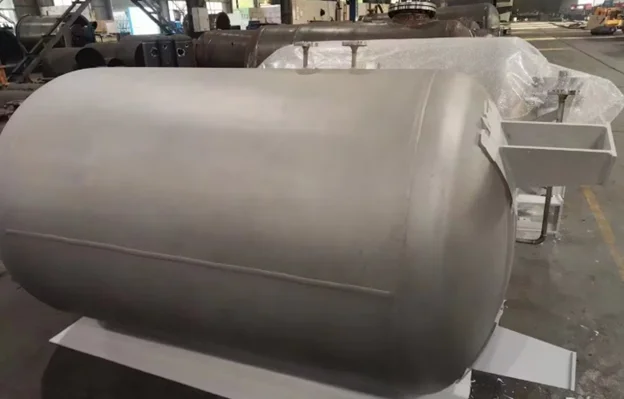
For over three decades, Nordstone has established itself as an engineering powerhouse in the design and manufacture of high-performance industrial vessels. Today, we leverage our 20 years of localized execution and specialized engineering expertise to emerge as one of the premier Hydrogen Storage Vessel manufacturers in UAE. Operating a state-of-the-art manufacturing facility, our expert team designs customized, zero-leak storage systems capable of containing gaseous and liquid hydrogen under extreme high-pressure regimes, varying temperature thresholds, and highly corrosive conditions.
As the United Arab Emirates accelerates its National Hydrogen Strategy to capture global market share by 2031, industrial infrastructure demands absolute precision. Nordstone bridges this gap by engineering Type I to Type IV hydrogen vessels built explicitly to counteract specialized failure modes like hydrogen embrittlement. Every vessel we fabricate complies strictly with international and regional safety directives—including ASME Section VIII Div. 1 & 2, ISO 11114-1/2, and IECEx Group IIC explosive atmosphere safety standards. From localized buffering tanks for electrolyzers to massive industrial storage skids for the defense, transport, and energy sectors, Nordstone provides the foundational reliability required to power the UAE’s green and blue hydrogen revolution.
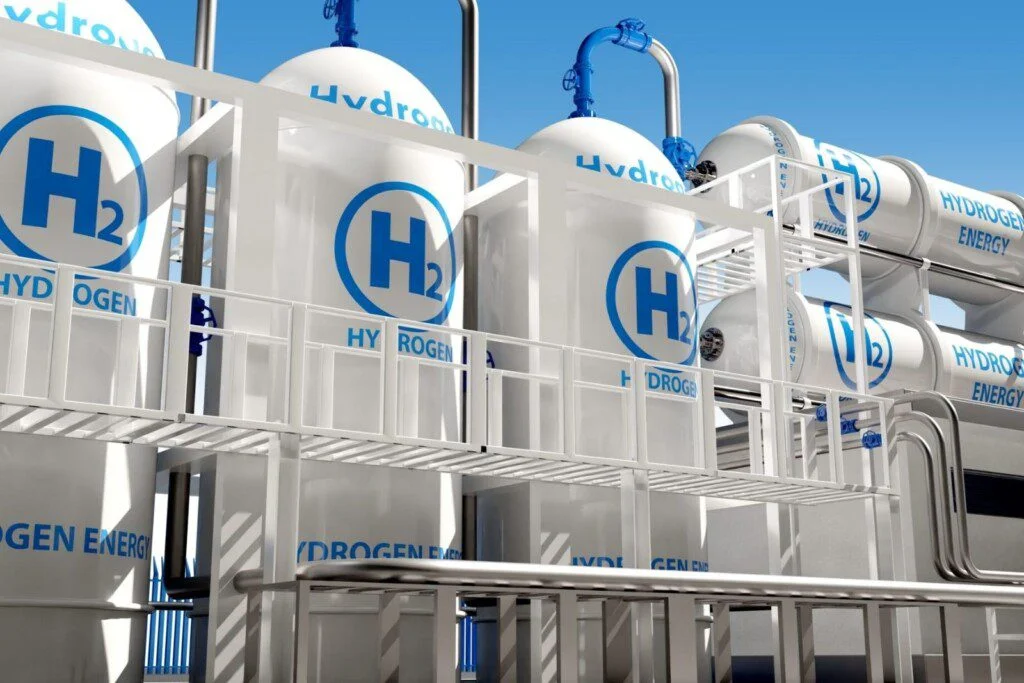
Technical Specifications & Classifications
To ensure long-term structural integrity and volatile gas containment, we specialize in diverse vessel architectures tailored to specific industrial workflows:
Hydrogen Vessel Structural Types
- Type I (All-Metal Vessels): Constructed from high-strength low-alloy steels (such as SA 372 or SA 516 Gr.70) and austenitic stainless steels (SS316L). Engineered for stationary industrial storage and pressure ranges from 30 to 200 bar. nordstonein.com
- Type II (Hoop-Wrapped Hybrid): Features a thick metallic steel/aluminum liner reinforced by partial carbon-fiber composite wrapping to reduce overall weight while handling medium-to-high pressure applications. nordstonein.com
- Type III (Full Composite, Metal Liner): Designed with an aluminum inner liner wrapped completely in a high-fatigue-resistant carbon-fiber reinforced polymer, holding pressures up to 450 bar. Ideal for localized refueling stations.
- Type IV (Composite, Polymer Liner): Features an advanced, non-corrosive polymer liner wrapped entirely in high-strength carbon fiber. Engineered to support extreme high-pressure regimes up to 700 bar for aerospace, mobility, and transport networks. nordstonein.com
Frequently Asked Questions
1. What makes hydrogen storage vessels different from standard industrial pressure vessels?
Hydrogen possesses a highly volatile flammability range (4–75% by volume in air) and the smallest molecular structure of any element. Standard pressure vessels are vulnerable to severe micro-leakage and chemical degradation when exposing standard carbon steels to high-pressure hydrogen. Specialized hydrogen storage vessels utilize specific, ultra-low permeability alloys, precise heat treatments, and elite sealing systems to guarantee structural longevity and zero gas escape.
nordstonein.com
2. How does Nordstone prevent hydrogen embrittlement in its UAE-manufactured vessels?
Hydrogen embrittlement occurs when atomic hydrogen diffuses into a metal’s crystalline lattice, causing cracking and catastrophic structural failure. Nordstone mitigates this by using strictly validated, hydrogen-compatible metals like austenitic stainless steel (SS316L) with controlled nickel content, or specialized Chrome-Moly steels. Furthermore, we implement rigorous Post-Weld Heat Treatment (PWHT) cycles and microstructural refinements to lower hardness levels below susceptible thresholds according to ISO 11114 standards.
nordstonein.com
3. What design codes and certifications do your hydrogen vessels comply with?
Every vessel engineered in our facility undergoes strict third-party verification (including TUV, Lloyds, Bureau Veritas, or DNV) and adheres to:
- ASME Section VIII Division 1 & 2 (with U-Stamp authorization on request) nordstonein.com
- ISO 11114-1 & 2 (Material compatibility for transportable gas cylinders)
- IEC 60079-10-1 & UAE ECAS-Ex (Explosive atmosphere and area classification standards)
- EN 13445 (Unfired pressure vessels) nordstonein.com
4. What pressure ranges can Nordstone’s hydrogen storage units handle?
We engineer solutions categorized across all primary pressure regimes:
- Low Pressure (10–30 bar): Common for raw industrial process storage and post-production buffering.
- Medium Pressure (30–100 bar): Ideal for PSA (Pressure Swing Adsorption) purification system storage.
- High Pressure (200–700 bar): Utilized for deep-volume commercial storage and fast-fill hydrogen refueling stations (HRS).
5. Are your vessels suitable for both green and blue hydrogen installations in the UAE?
Yes. Our custom vessels integrate seamlessly across both production paths. For green hydrogen installations, they act as reliable buffers connected directly to water electrolysis plants powered by solar farms. For blue hydrogen setups, they integrate into steam methane reforming (SMR) or autothermal reforming (ATR) units alongside carbon capture systems within regional industrial clusters like Ruwais.
6. What testing and quality control protocols do you use to ensure a zero-leak environment?
Safety is non-negotiable at Nordstone. Our quality control tracking includes 100% Non-Destructive Testing (NDT) via Radiographic Testing (RT) and Ultrasonic Testing (UT). Final leak tightness is certified using high-sensitivity Helium Mass Spectrometry leak detection alongside mandatory high-pressure hydraulic burst and pneumatic proof testing.
nordstonein.com
7. What types of internal and external coatings are applied to your vessels?
To defend against external environmental stressors—such as high ambient humidity, salinity, and extreme temperatures across the UAE coastlines—we apply near-white grit blasting (Sa 2.5) followed by robust external polyurethane/epoxy paint systems. Internally, vessels receive advanced surface treatments like electrochemical polishing or specialized diffusion-resistant polymer liners based on the vessel type.
nordstonein.com
8. Do your engineering designs meet ADNOC and local UAE utility guidelines?
Yes, our engineering protocols align with regional frameworks, including the Abu Dhabi Department of Energy (DoE) regulations, specific ADNOC industrial engineering safety standards, and Ministry of Industry and Advanced Technology (MoIAT) guidelines. We ensure all electrical, control, and sensory instruments mounted on the vessel carry the appropriate IECEx Group IIC T1-T4 classification required for hazardous zones in the UAE.
9. Can Nordstone supply skid-mounted or modular storage configurations?
Absolutely. To minimize on-site installation timelines and mechanical footprints, we specialize in fabricating completely modular, skid-mounted, or containerized vessel packages. These come pre-piped, pre-wired, and fully integrated with safety instrumentation, automated isolation valves, and vent lines, allowing for plug-and-play installation.
nordstonein.com
10. What is the standard capacity range for Nordstone industrial hydrogen vessels?
Our structural engineering capacity spans from compact 100-liter storage cylinders intended for fuel cells and localized testing, up to 80,000-liter heavy-duty industrial gas storage tanks. Custom, multi-vessel manifold banks can be scaled up to 200 cubic meters (200 m3) to meet vast energy storage requirements.
nordstonein.com
11. What instrumentation comes standard with your hydrogen storage systems?
Every vessel configuration is paired with a safety-first instrumentation envelope. This includes dual-redundant Safety Relief Valves (SRV), automated nitrogen purging ports, localized temperature transmitters, precise electronic pressure gauges, and manual/automatic low-point drain nozzles to purge moisture without losing process gas.
12. How do you optimize vessels against high thermal fluctuations common in the UAE?
Ambient temperatures in the UAE can exceed 50°C during peak summer months, which causes gas expansion and pressure variance. We counter this by integrating precision thermal insulation jackets, reflective exterior UV coatings, and robust finite element analysis (FEA) during the engineering phase to account for intensive thermal-mechanical cycling.
13. What is the expected operational lifespan of a Nordstone hydrogen vessel?
By utilizing ultra-premium material choices, rigorous fatigue-resistant welding details, and robust corrosion defense systems, our high-pressure vessels are designed for a decades-long active service life. Regular statutory inspections are simplified via our smart testing access ports and optimized NDT-friendly design layouts.
nordstonein.com
14. Can you manufacture cryogenic liquid hydrogen storage vessels?
Yes. While high-pressure compressed gas storage is our primary high-volume request, we engineer specialized double-walled, vacuum-insulated pressure vessels designed specifically to handle liquid hydrogen storage at cryogenic temperatures (-253°C).
nordstonein.com
15. How do we initiate a custom design consultation and procurement cycle?
To begin evaluating your specific pressure requirements, material needs, and dimensional footprints, please connect directly with our regional engineering team through our formal channels at our page: Contact
Our technical experts will provide a comprehensive engineering assessment, FEA sizing, and commercial quote tailored to your project’s strict timeline.