Nordstone is a premier Stripper Columns manufacturer in the UAE, delivering specialized mass transfer equipment designed to separate volatile components from liquid streams across processing facilities.
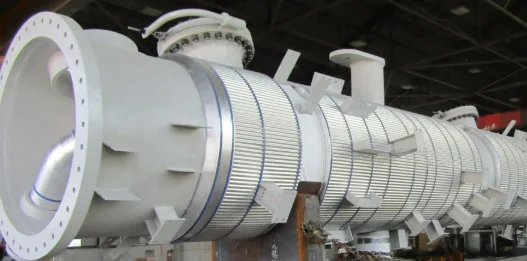
Backed by 20 years of industrial experience, we design and manufacture high-performance steam strippers, sour water strippers, and gas stripping towers that handle severe chemical media, extreme temperatures, and high operational pressures.
Every custom vessel is engineered to optimize liquid-vapor equilibrium and mass transfer efficiency, ensuring compliance with environmental standards and downstream processing requirements.
Our engineering team utilizes advanced finite element analysis (FEA) and computational fluid dynamics (CFD) alongside specialized software like PV Elite to design robust trayed or packed column architectures. Built entirely within our state-of-the-art manufacturing facility, Nordstone stripper columns are fabricated from corrosion-resistant alloys (CRAs) including Duplex 2205, Super Duplex, and Monel claddings to eliminate amine-induced or sour gas corrosion. Adhering strictly to ASME Section VIII Division 1 & 2 and API codes, we implement rigorous non-destructive testing (NDT), including radiography and ultrasonic testing, to guarantee structural integrity before field deployment. From localized chemical processing to large-scale upstream oil treatment, Nordstone provides turnkey separation solutions that reduce volatile organic compounds (VOCs) and hazardous gases while extending the life cycle of industrial process lines.
To discuss your specific project metrics, material specifications, or custom dimensional demands with our engineering desk, visit our Contact Us page to connect with our technical consultants.
Frequently Asked Questions
1. What mechanical design codes govern the manufacturing of stripper columns in the UAE?
Stripper columns manufactured for use in the UAE oil, gas, and petrochemical sectors are designed and fabricated in strict accordance with ASME Section VIII Division 1 or Division 2 for pressure containment and API standards for industry-specific process integrations. Wind and seismic design parameters are calculated based on localized UAE structural codes (such as ADM or Dubai Municipality regulations) to safeguard tall vertical columns against environmental loading.
2. Which materials of construction are utilized to prevent corrosion in sour water stripping?
Sour water stripping applications involve high concentrations of hydrogen sulfide ($\text{H}_2\text{S}$) and ammonia ($\text{NH}_3$), which induce severe stress corrosion cracking. Nordstone utilizes high-tier corrosion-resistant alloys (CRAs) such as Duplex 2205, Super Duplex 2507, 316L Stainless Steel, or carbon steel with metallurgical bond claddings (such as Monel or Inconel) to withstand these corrosive chemical environments.
3. What is the fundamental operational difference between trayed and packed stripper columns?
- Trayed Columns: Utilize specialized internal stages (bubble cap, valve, or sieve trays) where the downward liquid mixes with upward gas at distinct intervals. They are ideal for high liquid fluid volumes, varying process loads, and applications prone to fouling.
- Packed Columns: Utilize random or structured packing grids to create a continuous, thin-film liquid-gas interface. They offer a significantly lower pressure drop and are highly effective for vacuum stripping or systems sensitive to thermal degradation.
4. Can Nordstone manufacture large-scale stripper columns entirely in-house?
Yes. Our state-of-the-art manufacturing facility features heavy-duty rolling machines, automated sub-arc welding (SAW) stations, and massive overhead crane capacities. We manage complete in-house fabrication for heavy wall thicknesses, large diameters, and column lengths spanning up to several meters, delivering structural precision from initial plate rolling to final hydrostatic pressure testing.
5. How does a stripper column function within an oil and gas refinery line?
A stripper column operates on the principle of mass transfer driven by relative volatility. A liquid stream containing volatile contaminants is fed from the top, while a stripping medium (such as steam, air, or methane gas) is injected at the bottom. As they pass counter-currently, the stripping agent lowers the partial pressure of the volatile components, forcing them into the vapor phase to be discharged at the top, leaving the purified liquid to exit the bottom.
6. What testing and quality procedures are applied to ensure column safety?
Every vessel undergoes rigorous non-destructive testing (NDT) protocols. This includes 100% Radiographic Testing (RT) on longitudinal and circumferential weld seams, Ultrasonic Testing (UT) for laminate detection, Dye Penetrant Testing (PT), and Magnetic Particle Inspection (MPI). Following internal assembly, a mandatory hydrostatic test is conducted at a minimum of 1.3 times the maximum allowable working pressure (MAWP) to ensure absolute structural safety.
7. How does Nordstone optimize columns for thermal expansion during high-temperature operations?
Since steam stripping requires high-temperature inputs, thermal expansion can cause massive physical stress on vertical towers. We integrate specialized sliding or slotted foundation skirts, expansion joints, and strategically placed pipe guides. This allow the column to expand vertically without generating high bending stresses on the structural anchor bolts or connecting nozzles.
8. What software tools do your engineers use for mechanical calculations?
Nordstone utilizes industry-standard design tools including PV Elite for comprehensive ASME Section VIII calculations, vessel wall thick-sizing, and nozzle reinforcement analysis. For specialized aerodynamic or structural issues, we run Finite Element Analysis (FEA) for localized nozzle loading and Computational Fluid Dynamics (CFD) to optimize vapor-liquid inlet distribution behavior.
9. Why is uniform liquid distribution critical inside packed stripping towers?
If the liquid feed is not uniformly distributed across the top of a packed bed, it will track toward the vessel walls—a phenomenon known as channeling. This disrupts the counter-current gas contact, dropping mass transfer efficiency. Nordstone designs custom high-performance liquid distributors (trough or spray-nozzle patterns) to ensure uniform wetting across the entire cross-sectional area of the packing.
10. Can Nordstone retrofit or replace internals for existing stripper columns in the UAE?
Yes. Beyond new equipment manufacturing, our technical team provides turnaround services across the UAE to replace corroded or inefficient internals. We optimize existing assets by upgrading outdated sieve trays to high-efficiency valve trays or replacing old random packing with high-surface-area structured packing to increase throughput capacity.
11. What are the key process parameters required to quote a custom stripper column?
To initiate a custom design and mechanical quotation, our engineering desk requires:
- Design Pressure and Design Temperature.
- Full chemical composition of the feed liquid and gas medium.
- Corrosion allowance margins and preferred metallurgy.
- Volumetric or mass flow rates.
- Desired separation efficiency or maximum residual VOC/gas limits.
12. How does Nordstone handle shipping and transport logistics for oversized columns in the UAE?
Oversized process columns qualify as Heavy Lift / Out-of-Gauge (OOG) cargo. Nordstone coordinates specialized transport logistics, utilizing multi-axle hydraulic trailers, secure route planning, and municipal transport permits to safely deliver massive columns directly from our manufacturing facility to onshore or offshore deployment sites across the UAE.
13. What certifications accompany a completed Nordstone stripper column?
Each manufactured column is delivered with a complete Manufacturer’s Data Report (Form U-1 for ASME). The documentation package includes material test reports (MTRs) for all pressure-retaining plates, certified welding inspection records (WPS/PQR), non-destructive testing (NDT) sign-offs, hydrostatic test charts, and third-party inspector certification stamps.
14. What is the typical operating life cycle of a Nordstone industrial vessel?
By utilizing rigorous corrosion allowances, precise post-weld heat treatment (PWHT) to relieve internal mechanical stresses, and high-performance metallurgy, our stripper columns are engineered for an operational life cycle exceeding 20 to 25 years under standard maintenance and inspection intervals.
15. How do we get in touch with Nordstone for an engineering review or RFQ?
For technical consultations, detailed engineering layout reviews, or to submit a Request for Quotation (RFQ), please navigate directly to our official corporate portal at Contact Us. Our local UAE engineering desk will review your mechanical requirements and respond with a comprehensive technical framework.