Nordstone stands at the forefront as premier Fixed-Bed Reactors manufacturers in UAE, engineering high-performance catalytic and non-catalytic processing systems for critical applications.
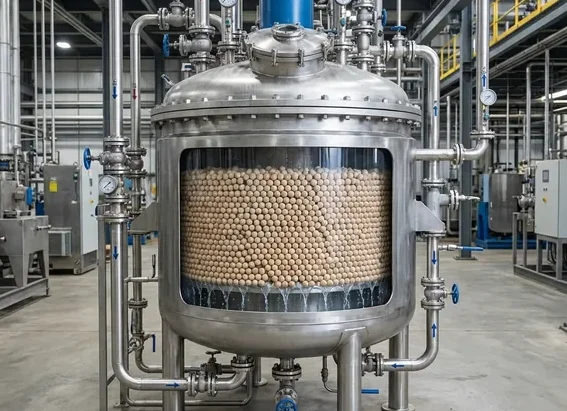
For over three decades, our group has specialized in the mechanical design, precision manufacturing, and code-stamping of industrial vessels. This domain expertise ensures that every fixed-bed reactor (also known as a packed-bed reactor) we manufacture delivers optimized fluid dynamics, maximum catalyst longevity, and uniform heat distribution.
From major refining hubs in Abu Dhabi to chemical processing zones in Dubai and Sharjah, our equipment forms the robust foundation of regional downstream infrastructure.
Our heavy-duty fixed-bed reactors are purpose-built to navigate the challenges of the energy transition, petrochemical processing, and specialty chemical synthesis.
By leveraging advanced finite element analysis (FEA) and computational fluid dynamics (CFD), our engineering team designs multi-tubular and single-bed systems capable of managing volatile exothermic or endothermic reactions. We meticulously build each reactor using advanced metallurgy, ranging from HIC-resistant carbon steel to exotic alloys like Duplex, Inconel, and Hastelloy. Certified to the highest international quality markers, Nordstone guarantees uncompromised reliability and operational safety for the region’s most demanding industrial environments.
To discuss your process specifications, sizing constraints, or custom metallurgy requirements with our senior engineering team, please visit our CONTACT US page.
Frequently Asked Questions (FAQ)
1. What is a fixed-bed reactor, and how does it function?
A fixed-bed reactor (or packed-bed reactor) is a cylindrical pressure vessel containing a stationary bed of catalyst pellets, structured packing, or inert materials. Reactant fluids (gas or liquid) are pumped through the stationary bed, where chemical transformation takes place on the catalyst surface. They are widely utilized due to their high conversion rates per weight of catalyst and excellent continuous flow stability.
2. What certifications do Nordstone fixed-bed reactors carry?
Every industrial reactor we build complies strictly with absolute international quality frameworks. Our facility is fully authorized to manufacture and code-stamp vessels under ASME Section VIII Div. 1 & Div. 2 (U, U2, R stamps), alongside API 12J, ISO 9001, ISO 14001, and ISO 45001 standards. This ensures complete regulatory compliance within UAE oil & gas operations.
3. Which specific industrial sectors in the UAE use your reactors?
Our custom chemical reactors primarily serve:
- Oil & Gas Refining: Hydrotreating, hydrocracking, and catalytic reforming.
- Petrochemicals: Production of ethylene, ammonia, methanol, and polymer precursors.
- Decarbonization & Clean Energy: Carbon capture utilization (CCU) and synthetic fuel production.
- Specialty Chemicals: Fine chemical synthesis and pharmaceutical intermediate production.
4. How does Nordstone prevent thermal runaway in exothermic fixed-bed processes?
Managing high-heat reactions is a critical core competency. We employ a dual strategy: advanced mechanical configurations—such as multi-tubular designs where reactants pass through small tubes surrounded by a circulating coolant jacket—and strategically placed multi-point thermowells. These thermowells track exact internal temperature profiles across the bed, allowing control systems to mitigate hot spots before thermal runaway occurs.
5. What materials of construction (MOC) do you offer for corrosive environments?
To fight severe corrosion, hydrogen blistering, and high-temperature oxidation, we offer a wide array of specialized metallurgy:
- Austenitic & Ferritic Stainless Steels: SS316L, SS317L, and SS310S.
- Duplex & Super Duplex Steels: For high mechanical strength and chloride pitting resistance.
- High-Nickel Alloys: Inconel 625/825, Monel 400, and Hastelloy C276.
- Cladded Options: Heavy carbon steel structural shells utilizing corrosion-resistant alloy (CRA) weld overlays to lower total capital expenditure.
6. Can your vessels manage high-pressure and high-temperature (HPHT) applications?
Yes. Supported by our 20 years of technical experience, our units are engineered for demanding conditions, handling pressures from full vacuum up to 200 bar and operating temperatures spanning –50°C up to +600°C. Each boundary wall thickness calculation is verified via PV Elite software to satisfy safety margins.
7. What is the typical life expectancy of a Nordstone industrial vessel?
When operated within original design parameters and subjected to routine turnaround maintenance, our fixed-bed reactors boast a service life exceeding 20 to 25 years. We achieve this long lifespan by adding precise corrosion allowances and utilizing premium-grade, fully traceable materials.
8. Do you provide custom-engineered flow internals for catalyst support?
We design and install optimized internal components, including gas/liquid inlet diffusers, catalyst support grids, hold-down screens, and outlet collectors. These internals are carefully engineered to distribute incoming fluids evenly, preventing channeling and localized catalyst crushing.
9. How does Nordstone assure the quality of its pressure welds?
Our internal quality assurance program involves comprehensive, non-destructive testing (NDT). All critical pressure-retaining welds undergo:
- Radiographic Testing (RT) and Ultrasonic Testing (UT) for sub-surface inspection.
- Magnetic Particle Testing (MPI) and Dye Penetrant Testing (DPT) for surface flaws.
- Final Hydrostatic pressure tests at code-mandated multipliers to guarantee seal integrity. nordstoneng.com
10. Can you manufacture skid-mounted modular reactor units?
Yes, we specialize in fabricating complete, turnkey skid-mounted process packages. We integrate the fixed-bed reactor with necessary piping, high-pressure dosing pumps, preheaters, heat exchangers, control valves, and automated instrumentation on a single structural skid for fast plug-and-play installation on-site.
11. What parameters are evaluated during your computational design phase?
Our engineering team utilizes Finite Element Analysis (FEA) to look closely at localized nozzle loading and cyclic thermal stresses. Simultaneously, Computational Fluid Dynamics (CFD) is deployed to model fluid velocities, verify pressure drop parameters across the catalyst bed, and prevent stagnant zones.
12. How do you simplify the process of loading and unloading heavy catalysts?
We place custom-designed, quick-opening top manways for seamless catalyst charging, along with dedicated bottom or side-delivery nozzle ports for gravity-assisted vacuum catalyst unloading. This minimizes plant downtime during critical turnaround windows.
13. What surface finishes and protective coatings are applied to your vessels?
For external protection against coastal salt-spray and humid industrial environments across the UAE, we apply high-build zinc primers followed by polyurethane epoxy coating systems. Internal surfaces can receive specialized glass-flake or phenolic linings if required by sour gas processes.
14. What documentation is delivered alongside a finished reactor vessel?
Every reactor ships with a comprehensive Manufacturing Data Book (MDB). This verified package includes material test certificates (MTCs), weld logs (WPS/PQR), NDT clearance sheets, third-party inspection releases, pressure charts, and code stamp certifications.
15. How can I request an engineering proposal or quote from Nordstone?
To receive a tailored technical and commercial proposal, you can securely submit your process datasheets, chemical compositions, and mechanical requirements directly through our Contact Us portal. Our application engineers will review your parameters and provide a detailed response.