As a leading surge tank manufacturer in the UAE, Nordstone leverages over 20 years of engineering excellence to design and manufacture high-performance industrial vessels.
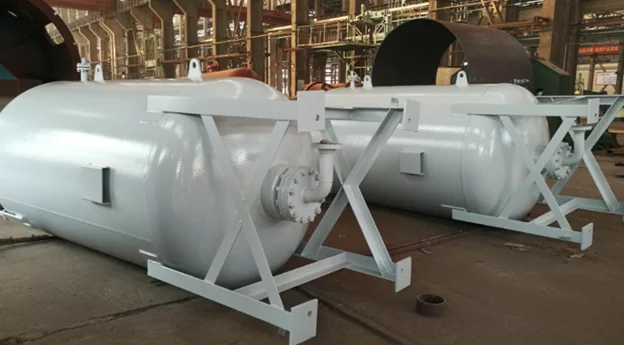
Our custom-engineered surge tanks are specifically fabricated to withstand the extreme pressures, fluctuating temperatures, and highly corrosive environments characteristic of the Middle East’s oil and gas, petrochemical, and water treatment sectors. Operating from our state-of-the-art manufacturing facility, our expert engineers ensure every vessel complies with stringent global benchmarks, including ASME Section VIII, API, and ISO certifications. By integrating advanced pulsation dampening and pressure regulation technologies, Nordstone surge tanks provide critical protection for pipelines and downstream equipment against catastrophic water hammer and fluid transients.
Whether your project requires standard configurations or bespoke, heavy-wall process vessels, Nordstone delivers unmatched operational reliability, meticulous quality control, and robust safety standards to safeguard your critical industrial infrastructure across the Emirates.
For custom engineering specifications or to discuss your project requirements with our technical team, visit our Contact Us page.
Frequently Asked Questions (FAQs)
1. What is the primary function of an industrial surge tank?
An industrial surge tank acts as a temporary storage and pressure-neutralizing reservoir within a fluid transport system. Its primary role is to absorb sudden pressure spikes (surges) and neutralize the vacuum effects caused by rapid fluid acceleration or deceleration, thereby protecting pipelines and downstream instrumentation from structural failure.
2. How do Nordstone surge tanks protect against water hammer?
Water hammer occurs when a fluid in motion is forced to stop suddenly (e.g., valve closure or pump trip), creating severe shockwaves. Nordstone surge tanks provide an immediate cushion—either using a gas blanket or an open-top column—allowing the excess fluid volume to divert into the tank, dissipating the kinetic energy safely and preventing pipeline rupture.
3. Which design codes and standards does Nordstone follow for manufacturing?
All our surge tanks and industrial pressure vessels are engineered and fabricated in strict accordance with international standards, primarily ASME Section VIII (Div 1 & 2), API 650/620, and ISO 9001:2015 quality management frameworks to ensure absolute mechanical integrity.
4. What materials are typically used for surge tanks operating in the UAE?
Given the highly corrosive coastal and desert environments in the UAE, we utilize premium corrosion-resistant materials. These include high-tensile carbon steel (with specialized internal/external coatings), 316L stainless steel, duplex stainless steel, and super duplex stainless steel for high-salinity or sour gas applications.
5. Can Nordstone customize surge vessels for extreme high-pressure or high-temperature environments?
Yes. Backed by over two decades of heavy fabrication experience, our engineering team specializes in custom wall-thickness calculations, thermal stress analysis, and alloy selection to deliver bespoke vessels capable of operating under extreme cyclic pressures and high-temperature process conditions.
6. What industries in the UAE benefit most from your surge tanks?
Our primary clients span critical infrastructure sectors across the UAE, including:
- Oil & Gas (Upstream & Midstream): Managing crude oil and produced water transients.
- Desalination & Water Distribution: Protecting cross-country water transmission networks.
- Petrochemical Plants: Stabilizing chemical feedstocks.
- Power Generation & Defence: Managing high-pressure cooling loops and critical utilities.
7. What is the difference between a bladder-type surge tank and an air-cushioned surge tank?
- Bladder-type tanks utilize a heavy-duty elastomer bladder to separate the process fluid from the compressed air or nitrogen gas, preventing gas absorption into the fluid and reducing maintenance.
- Air-cushioned (or gas-blanketed) tanks feature direct contact between the fluid and gas phase, often requiring a automated gas charging system to maintain the correct cushion volume. We manufacture both configurations based on your specific process dynamics.
8. How does the UAE climate influence surge tank design?
The UAE’s high ambient temperatures (often exceeding 50°C in summer) and high relative humidity accelerate atmospheric corrosion and impact gas-volume expansion rates inside pressure vessels. Nordstone compensates for this by applying specialized multi-coat epoxy or polyurethane UV-resistant external coatings, and optimizing the thermal expansion allowances in our mechanical designs.
9. What non-destructive testing (NDT) protocols do you implement?
To guarantee zero-defect manufacturing, we execute rigorous quality control checks, including:
- Radiographic Testing (RT) and Ultrasonic Testing (UT) for weld integrity.
- Magnetic Particle Testing (MT) and Dye Penetrant Testing (PT) for surface flaws.
- Hydrostatic Pressure Testing at a minimum of 1.3 times the maximum allowable working pressure (MAWP).
10. Do you provide sizing and transient surge analysis support?
While we primarily manufacture based on client-provided process parameters, our engineers collaborate closely with your project teams to review transient surge analyses, ensuring the physical vessel dimensions, nozzle orientations, and pressure ratings perfectly align with your hydraulic system modeling.
11. What connection and nozzle configurations are available?
We provide fully customized nozzle configurations, including flanged connections (ANSI/ASME B16.5), threaded fittings, manways for internal inspection, instrument ports for level/pressure transmitters, and specialized lifting lugs designed for safe transport and site installation.
12. Are Nordstone surge tanks compatible with sour gas (H2S) environments?
Yes. For oil and gas applications involving sour service, we manufacture vessels that comply strictly with NACE MR0175 / ISO 15156 standards. This involves using HIC (Hydrogen-Induced Cracking) resistant steels and post-weld heat treatment (PWHT) to eliminate residual stress.
13. What is the typical lifespan of a Nordstone industrial surge tank?
When operated within designated design parameters and subjected to routine maintenance, our surge tanks are engineered for a design life of 20 to 30+ years, backed by our robust structural engineering and premium corrosion allowance strategies.
14. How do I initiate a request for a quote (RFQ) for a project in Abu Dhabi or Dubai?
You can submit your technical datasheets, piping and instrumentation diagrams (P&IDs), and mechanical requirements directly through our online engineering portal. Please visit our dedicated Contact Us page to connect with our regional technical sales team in the UAE.
15. What lead times can we expect for custom vessel fabrication?
Lead times vary depending on the vessel volume, material availability (such as specialized alloys), and the complexity of the design codes. Generally, standard carbon steel surge vessels range from 12 to 16 weeks, while complex, heavy-wall exotic alloy vessels are scheduled based on explicit project milestones.