For over three decades, Nordstone has been a premier leader in designing and manufacturing high-performance industrial vessels and heavy-duty water treatment infrastructure across the UAE (Aquapro LLC; UltraTec).
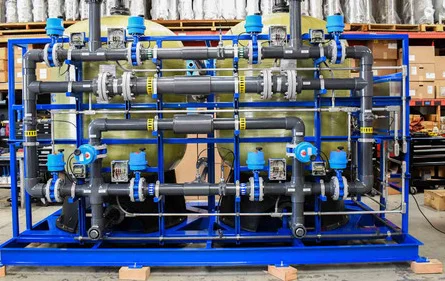
Backed by 20 years of localized engineering expertise, we specialize in heavy-duty multimedia filter vessels engineered to withstand the Middle East’s harshest operating environments. Our state-of-the-art production facilities design multi-layer pressure filtration systems that effectively minimize the Silt Density Index (SDI) and eliminate Total Suspended Solids (TSS) down to 5–10 microns (Puretec Industrial Water).
Whether managing seawater desalination pretreatment in Abu Dhabi, treating heavy industrial wastewater in Dubai, or supporting critical oil and gas operations, Nordstone ensures unyielding reliability.
Every multimedia filter vessel we deliver is custom-built to mitigate high pressure drops and resist aggressive, corrosive conditions (J Mark Systems). Built in strict compliance with ASME, API, and ISO certifications, our filtration systems guarantee structural integrity and long-term asset protection under extreme pressures and temperatures.
From automated pneumatic face-piping assemblies to specialized internal distributors, our engineers tailor the internal architecture to maximize dirt-holding capacity and drastically extend operational run times between backwash cycles (Pure Aqua. Inc.; Puretec Industrial Water). We match rigorous quality control with robust materials of construction—including heavy-gauge carbon steel, corrosion-resistant stainless steel, and specialized interior epoxy linings—to keep your downstream equipment safe from premature fouling (Pure Aqua. Inc.; Puretec Industrial Water). Don’t settle for off-the-shelf equipment when your critical operations require precision-engineered protection. To secure a tailored, robust filtration solution built exactly to your plant’s flow rates and structural configurations, connect with our engineering team today through our Contact Us page to request a detailed technical consultation and quote.
Frequently Asked Questions (FAQs)
1. What is a multimedia filter, and how does it work?
A multimedia filter (MMF) is an advanced pressure filtration vessel that uses multiple layers of distinct granular media stacked by density and particle size to remove suspended solids from water (Pure Aqua. Inc.). Unlike single-media sand filters, water flows downward through progressively finer and denser layers (typically anthracite, silica sand, and garnet supported by a gravel base) (Puretec Industrial Water). The larger, lighter anthracite on top traps coarse particles, while the finer, heavier sand and garnet lower down capture microscopic turbidity, maximizing the entire bed’s dirt-holding capacity (Puretec Industrial Water).
2. Why are Nordstone multimedia filters preferred for industrial applications in the UAE?
The UAE’s industrial sectors face unique environmental challenges, including highly saline feed water, extreme ambient heat, and fine desert silt. Nordstone designs and manufactures robust, heavy-duty industrial vessels backed by 20 years of localized engineering expertise. Our systems are built according to strict ASME and API codes, featuring heavy-gauge steel shells and specialized internal coatings capable of handling high temperatures, volatile pressures, and aggressively corrosive environments where standard fiberglass (FRP) tanks often fail (Pure Aqua. Inc.; Puretec Industrial Water).
3. What particle size can a Nordstone multimedia filter effectively remove?
A well-engineered industrial multimedia filter can mechanically remove suspended particles down to 15–20 microns on its own (Puretec Industrial Water). When coupled with upstream chemical dosing—such as an automated coagulant or flocculant injection system that binds tiny colloidal materials together—our filtration vessels can efficiently strip out particulates down to 5–10 microns (Pure Aqua. Inc.; Puretec Industrial Water).
4. What are the typical layers used in your multimedia filtration beds?
Our heavy-duty industrial filters typically utilize three primary media layers placed over a baseline support structure (Puretec Industrial Water):
- Top Layer: Anthracite coal (low density, largest grain size) to trap large debris (Puretec Industrial Water).
- Middle Layer: Silica sand (medium density, medium grain size) for intermediate particulate capture (Puretec Industrial Water; Kosun).
- Bottom Layer: Garnet sand (high density, fine grain size) for polishing out microscopic turbidity (Puretec Industrial Water).
- Underbed Support: Graded gravel or pebbles to ensure even hydraulic flow and prevent media migration into the internal bottom distributors (Pure Aqua. Inc.; Kosun).
5. When does a multimedia filter require a backwash cycle?
Industrial operators track two primary metrics to trigger a backwash (J Mark Systems):
- Pressure Differential (ΔP): When the pressure drop across the media bed increases by 10 psi (approximately 0.7 bar) over the clean baseline state, indicating the bed is choked with debris (J Mark Systems).
- Effluent Turbidity: A 10% or greater increase in product water turbidity, which means solids are beginning to break through the lower media layers (J Mark Systems). Alternatively, cycles can be programmed via a programmable logic controller (PLC) based on elapsed runtime or volumetric throughput (Pure Aqua. Inc.).
6. What certifications do Nordstone multimedia filter vessels carry?
Every industrial pressure vessel manufactured by Nordstone is designed, fabricated, and rigorously inspected to satisfy international engineering benchmarks. Our manufacturing processes carry ASME Section VIII authorization for pressure vessels, alongside API and ISO 9001:2015 quality management certifications, ensuring compliance with strict safety and performance mandates across defense, municipal, and industrial frameworks.
7. How does an MMF protect downstream Reverse Osmosis (RO) membranes?
High Silt Density Index (SDI) and Total Suspended Solids (TSS) will cause rapid, premature colloidal fouling on sensitive RO membranes, driving up energy costs and requiring harsh chemical cleanings. Utilizing a multimedia filter as an absolute pretreatment step drops the feed water SDI to less than 3 and turbidity to less than 0.2 NTU, which directly preserves membrane life and optimizes desalination performance (Puretec Industrial Water).
8. Can Nordstone filters handle corrosive environments like seawater or chemical wastewater?
Yes, corrosion resistance is a fundamental cornerstone of our heavy vessel fabrication. For seawater applications, oilfield produced-water, or corrosive chemical streams, we build vessels utilizing advanced corrosion-resistant alloys (such as 316L Stainless Steel or Duplex steels) or apply specialized internal rubber or multi-coat epoxy linings (Pure Aqua. Inc.). Internals, face-piping, and control valves are upgraded to non-metallic or high-alloy variants to handle harsh chemical profiles (Pure Aqua. Inc.).
9. What materials are used for the face-piping and internal distribution systems?
Depending on your process requirements, temperature, and chemistry, we offer highly customizable configurations (Pure Aqua. Inc.). For standard industrial water filtration, heavy-duty Schedule 80 PVC or epoxy-coated carbon steel is common (Pure Aqua. Inc.). For high-temperature, high-pressure applications, or oil and gas installations, we utilize full 316 Stainless Steel face-piping and custom-slotted stainless steel internal lateral hub distributors to prevent thermal degradation and chemical fatigue (Pure Aqua. Inc.).
10. What is the standard operational footprint and flow velocity for your systems?
Nordstone custom-engineers each vessel to fit your plant’s specific hydraulic layout. For optimal particulate removal and to prevent premature solids breakthrough, our systems are typically calculated around an ideal flux or service flow velocity of 3 to 7 gallons per minute per square foot (gpm/ft2), though specific velocities are adjusted based on your raw water analysis and targeted effluent criteria (Puretec Industrial Water).
11. What is the difference between a multimedia filter and a traditional sand filter?
A standard sand filter utilizes uniform sand grains; during backwashing, the smallest grains naturally settle on top, which causes the very top surface of the filter to choke quickly, leading to short run times. An MMF utilizes density differentials so that the largest grains (anthracite) remain on top after backwashing, utilizing the deep vertical space of the entire media bed to trap solids, resulting in much longer run times and higher filtration efficiency (Pure Aqua. Inc.; Puretec Industrial Water).
12. How much water is required for the backwash process, and how long does it take?
An industrial backwash cycle typically lasts between 10 to 15 minutes, forcing water upward through the vessel at a high velocity to expand and de-compact the media bed by 40% to 50% (Pure Aqua. Inc.). This fluidization flushes out trapped sediments into the drain line (Pure Aqua. Inc.). It is immediately followed by a short “rinse and settle” cycle (approx. 5–10 minutes) to allow the layers to re-stratify by density before returning to standard down-flow service (Pure Aqua. Inc.).
13. Does Nordstone offer fully automated control options for its filtration arrays?
Yes. We integrate complete automation solutions utilizing industrial-grade PLCs (such as Siemens or Allen-Bradley) housed in weatherproof, explosion-proof enclosures suitable for hazardous Zone 1 or Zone 2 desert environments. The system uses electronic or pneumatic control valves to autonomously cycle through backwash, rinse, and service phases based on differential pressure transmitters, completely eliminating the need for manual operator intervention (Pure Aqua. Inc.).
14. What are the core industrial sectors that use Nordstone filtration vessels in the region?
Our high-performance vessels are deployed across a diverse array of mission-critical sectors in the UAE, including:
- Pre-filtration for seawater reverse osmosis (SWRO) desalination plants.
- Cooling tower side-stream filtration and boiler feed water pretreatment (Aqua UAE).
- Produced-water treatment and injection water filtration in the Oil & Gas sector.
- Wastewater recycling and polishing loops within heavy manufacturing and defense facilities (Kosun; Aqua UAE).
15. How can I get a custom engineering design and quote for my facility?
To receive a tailored technical blueprint and commercial proposal, navigate directly to our Contact Us page. Please share your required flow rates, raw water analysis (including TSS, turbidity, and temperature), operating pressure limits, and space constraints, and our team of senior application engineers will configure a solution tailored to your exact project parameters.