As leading TSand Filter Pressure Vessel manufacturers in UAE, Nordstone delivers heavy-duty, high-performance filtration solutions engineered specifically to withstand the Middle East’s aggressive operating environments. With over 20 years of experience in precision engineering and manufacturing, we specialize in high-efficiency industrial sand filter pressure vessels designed to eliminate suspended solids, turbidity, and particulate matter from critical process lines.
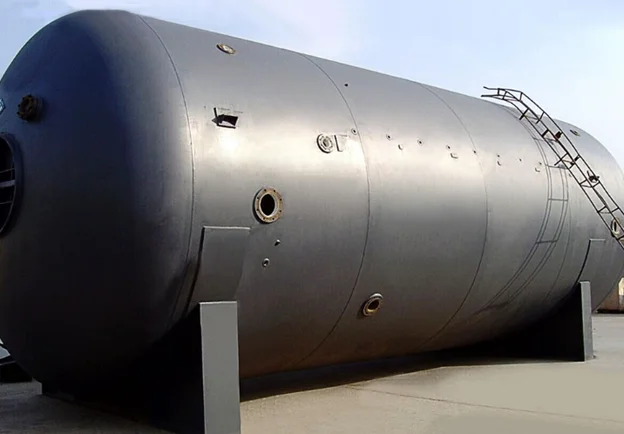
Our custom-engineered vessels are widely utilized across the UAE’s core industrial sectors—including Oil & Gas, desalination, wastewater treatment, and petrochemical processing. Fabricated strictly in compliance with ASME Section VIII Div 1, API, and ISO certifications, every pressure sand filter vessel we build guarantees structural integrity under extreme pressures and highly corrosive conditions.
By integrating advanced under-drain systems and uniform flow distributors, Nordstone ensures low pressure drops, optimized backwash cycles, and an extended lifespan for your filtration media.
To discuss your specific project parameters, material grades, or flow rate requirements with our expert engineering team, or to request a detailed technical quote, visit our Contact Us page today.
Frequently Asked Questions (FAQ)
Here are the top 15 technical questions regional engineers and procurement managers ask when sourcing industrial sand filtration vessels in the UAE.
1. What materials of construction (MOC) do you use for UAE sand filter pressure vessels?
We select premium materials based on the specific corrosivity of the process fluid. Common choices include carbon steel (ASTM A516 Gr. 70) with specialized internal chemical/anti-corrosion linings (like epoxy or rubber), stainless steel (304/316L), and duplex or super duplex stainless steels for high-salinity seawater desalination projects across the Emirates.
2. Are Nordstone’s TSand filter pressure vessels designed according to international codes?
Yes. Every pressure vessel is custom engineered and code-stamped according to ASME Section VIII Division 1 or Division 2 rules, depending on the operational pressure profile. We also ensure full compliance with API and ISO quality management workflows.
3. Can your filtration vessels withstand the high ambient temperatures of the UAE?
Absolutely. Our engineering team conducts rigorous thermal stress analysis alongside wind and seismic calculations during the design phase. Our vessels are rated for high-temperature fluid processing and insulated externally where necessary to preserve system efficiency and operator safety in harsh desert climates.
4. What types of media configurations can your vessels accommodate?
Our vessels are highly versatile. They can be built as Single-Media Sand Filters (utilizing graded silica sand) or configured as Multi-Media Filters using layered combinations of anthracite, silica sand, garnet, and gravel support beds to capture ultra-fine particulates.
5. What pressure ranges do your industrial sand filters support?
Our standard industrial pressure sand filters operate comfortably within a 4-20 bar range. However, because we specialize in custom manufacturing, we can engineer custom thick-walled vessels to withstand much higher design pressures for specific downstream applications.
6. Do you offer skid-mounted or pre-assembled filtration packages?
Yes, we offer completely integrated skid-mounted sand filter packages. These units arrive at your site pre-piped, hydro-tested, and equipped with required structural skids, multi-port or automated valve manifolds, and localized instruments, saving significant on-site installation time.
7. How does the internal distribution and under-drain system work?
To prevent channeling and ensure uniform liquid velocity across the entire sand bed, we design custom top header-lateral distributors and bottom under-drain strainers (hub-and-lateral or header-lateral setups). This ensures maximum solid-trapping efficiency during filtration and uniform bed expansion during backwashing.
8. What non-destructive testing (NDT) do you conduct before delivery?
Quality control is the cornerstone of our manufacturing. Every vessel undergoes exhaustive QA/QC procedures, including Hydrostatic and Pneumatic Testing, Radiographic Testing (RT) for weld seams, Ultrasonic Testing (UT), Dye Penetrant Inspection (DPI), and Magnetic Particle Inspection (MPI).
9. Do your vessels support automated backwashing systems?
Yes, our custom setups can be integrated with automated pneumatic or electrical valve manifolds. This allows for automated backwashing based either on differential pressure ($\Delta P$) setpoints or elapsed time intervals, minimizing manual maintenance and operator error.
10. Can you accommodate Third-Party Inspections (TPI)?
Yes. We regularly coordinate with leading global third-party inspection agencies active in the UAE (such as Bureau Veritas, TÜV, Lloyd’s Register, and DNV) to validate material traceability, structural welding, and pressure testing protocols.
11. What parameters are required to generate a custom technical quote?
To provide an accurate proposal, our engineering team requires details on your maximum flow rate ($m^3/hr$), design pressure and temperature, fluid characteristics, target filtration size (microns), available footprint, and any specific material or lining preferences.
12. How do you protect the vessels against external atmospheric corrosion in coastal UAE regions?
Coastal locations face highly saline, humid air. We apply heavy-duty marine-grade exterior coating systems (blasting to Sa 2.5 followed by inorganic zinc primers, epoxy intermediate layers, and polyurethane topcoats) to ensure maximum defense against atmospheric corrosion.
13. What is the typical life expectancy of a Nordstone sand filter vessel?
With proper maintenance, scheduled backwashing, and periodic sacrificial anode or lining checks, our robustly engineered carbon steel lined or alloy pressure vessels are built for a structural design life of 20 to 25+ years.
14. What nozzle connections and maintenance access configurations are available?
Our designs include flanged inlet/outlet nozzles (ANSI/ASME standards), dedicated backwash lines, air release valves, pressure gauge ports, instrument taps, and quick-opening or bolted structural manways (top and side) to allow safe access for media loading, removal, and internal inspections.
15. What is your standard manufacturing lead time for delivery within the UAE?
Lead times vary depending on the vessel size, chosen materials, design complexity, and material availability. Standard configurations generally range between 8 to 14 weeks from final engineering drawing approval.