As a leading industrial force with over 20 years of engineering experience, Nordstone specializes in the design, custom fabrication, and turnkey supply of high-performance packed columns across the UAE. Our state-of-the-art facilities produce rugged packed bed columns, distillation columns, and advanced gas-liquid separation towers tailored for the harsh operating environments of the Middle East.
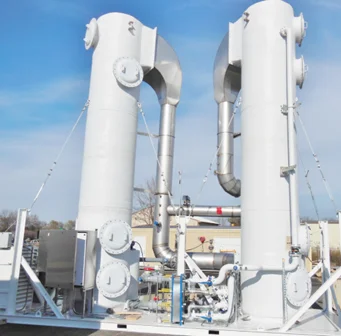
Engineered to withstand high pressure, extreme temperature fluctuations, and highly corrosive substances, our process systems utilize premium exotic alloys, stainless steels, and robust column internals to maximize mass transfer efficiency. From initial thermal design and AI-optimized fluid distribution modeling to rigorous physical structural testing, we ensure your mass transfer processes function with minimal pressure drops and optimal product yield.
To secure a custom design that meets strict international compliance frameworks, including ASME, API, and ISO standards, explore our bespoke chemical processing solutions and contact our technical engineering team today.
Frequently Asked Questions (FAQs)
1. What industrial applications do Nordstone packed columns serve in the UAE?
Our custom-engineered columns are deployed across the UAE’s critical industrial sectors. This includes oil and gas processing (refining, sour gas stripping, and glycol dehydration), petrochemical plants, marine scrubbing, chemical manufacturing, and environmental air pollution control systems.
2. What types of column internals do you manufacture?
We design and manufacture a comprehensive suite of high-efficiency column internals. This includes high-turn down liquid distributors, structured and random packing support plates, gas injection bypass plates, liquid collectors, and highly efficient bed limiters designed to prevent packing displacement during high-velocity gas surges.
3. Which material grades do you use for columns operating in corrosive environments?
Depending on the chemical severity of your application, we fabricate shells and internals using standard Stainless Steel (304, 316L), Duplex and Super-Duplex steels, Hastelloy, Titanium, and specialized polymer or ceramic materials for extreme acid-scrubbing operations.
4. Can Nordstone assist with retrofitting or revamping existing columns?
Yes. With two decades of heavy fabrication experience, our engineering team specializes in retrofitting older trayed towers or less efficient packed columns. We optimize internals and replace outdated random packing with advanced structured packing to drastically boost throughput and separation efficiency without expanding your physical footprint.
5. Do your packed columns comply with international safety and manufacturing standards?
Absolutely. Every industrial vessel and packed tower designed by Nordstone is engineered, built, and inspected under rigid quality frameworks. We hold recognized authorizations and certifications under ASME (U, U2, R stamps), API (620/650), and ISO 9001:2015 quality management protocols.
6. Why is liquid distribution so critical in a packed bed column?
Poor liquid distribution causes “channeling,” where the liquid flows down the column walls or clustered paths, bypassing the rising vapor. Our AI-optimized liquid distributors ensure uniform wetting across the entire cross-sectional surface area of the packing material, maximizing the mass transfer interface.
7. What is the difference between structured packing and random packing?
- Structured Packing: Features a corrugated, meticulously organized geometric structure that offers very low pressure drop, high fluid capacity, and excellent separation efficiency, making it ideal for vacuum systems or high-vacuum distillation.
- Random Packing: Utilizes bulk, unarranged pieces (like Raschig rings or saddles) dropped into the column. It is a highly cost-effective, versatile solution for high-pressure absorption and stripping processes.
8. How do you prevent structural failure under extreme pressures and temperatures?
We utilize advanced finite element analysis (FEA) and computational fluid dynamics (CFD) modeling during the design phase. This allows us to calculate exact thermal expansion stresses and mechanical wall-thickness requirements before fabrication even begins.
9. What testing parameters do you perform before dispatch?
Every packed column undergoes rigorous non-destructive testing (NDT), including:
- Radiographic and ultrasonic weld inspections.
- Hydrostatic and pneumatic pressure tests at elevated pressures.
- Positive material identification (PMI).
- Detailed dimensional checks to guarantee flawless fitment with your existing plant pipelines.
10. Can you handle large-scale, turnkey industrial skid integrations?
Yes, we engineer fully integrated process skids. We can deliver your packed column complete with integrated structural steel platforms, structural ladders, interconnecting piping, valves, instrumentation, and control systems, reducing on-site installation timelines in the UAE.
11. How do you handle shipping and logistics for oversized columns in the UAE?
We provide export-ready, heavy-duty industrial packaging and coordinate specialized logistics. Our team handles the entire transport logistics chain—from our manufacturing floors directly to your industrial site or oilfield base in Abu Dhabi, Dubai, Sharjah, or Ruwais.
12. What is the standard lifespan of a Nordstone packed column?
By utilizing precision CNC machining, strict weld-overlay techniques, and premium corrosion-resistant alloys, our heavy-duty columns are structurally designed to achieve an operational lifecycle exceeding 20 to 30 years under standard maintenance schedules.
13. How does Nordstone optimize columns for low pressure drops?
By deploying next-generation structured packing topologies alongside highly aerodynamic gas-injection support plates, we lower resistance to rising vapors. This directly lowers energy consumption across your plant’s main compressor and blower units.
14. What information is required to get an accurate manufacturing quote?
To provide an optimized mechanical and commercial proposal, we typically require your process data sheets detailing the operating pressure and temperature, chemical stream composition, required volumetric flow rates, metallurgy preferences, and desired design codes (e.g., ASME Sec VIII Div 1).
15. How can I submit a request for an engineering consultation?
You can directly upload your technical specifications, drawings, and RFP documentation through our secure online portal. Get in touch with our lead process engineers by visiting our dedicated Contact Us page for a rapid response.