For over three decades, Nordstone has established a reputation for engineering high-performance industrial vessels. We bring this deep expertise to the Gulf region as a leading Double-Pipe Heat Exchanger (DPHE) manufacturer in UAE. Our precision-engineered industrial solutions are designed to withstand the extreme pressures, temperatures, and corrosive environments typical of Middle Eastern industrial operations.
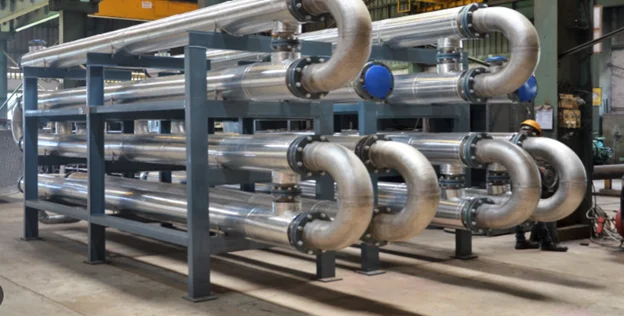
We serve critical sectors across Abu Dhabi, Dubai, and the wider GCC, including Oil & Gas, petrochemical processing, and defense. By utilizing true counter-current flow configurations, our modular custom thermal systems provide maximum heat transfer efficiency even within compact, space-constrained plant layouts. Every units is designed and manufactured in our state-of-the-art facility to meet stringent ASME Section VIII, API, and ISO criteria. This strict adherence to international engineering standards guarantees the structural integrity and operational safety of your thermal management systems. Whether your process demands high-fouling slurry management or precise sensible cooling of process fluids, our expert engineers deliver reliable, certified equipment optimized for long-term performance.
To explore custom sizing or to integrate our thermal systems into your facility, reach out to our team via our Contact Us page.
Frequently Asked Questions
1. What is a double-pipe heat exchanger (DPHE)?
A double-pipe heat exchanger is the simplest type of industrial thermal management system. It consists of one concentric pipe placed inside another larger pipe. One process fluid flows through the inner tube side while the other fluid flows through the outer shell side (or annulus), transferring thermal energy through the pipe wall without mixing.
2. Why should industrial facilities in the UAE choose Nordstone for DPHE manufacturing?
Nordstone combines over 20 years of technical expertise with specialized localized engineering for the UAE’s harsh environmental conditions. Our heat exchangers feature heavy-duty corrosion allowances, robust material selection for high ambient temperatures, and full compliance with regional international standards like ASME and API.
3. What are the primary industrial applications for double-pipe heat exchangers?
They are widely used across the Middle East for:
- Crude oil preheating and gas dehydration in the Oil & Gas sector.
- High-pressure boiler, compressor, and steam system cooling.
- Sensible heating and cooling of process chemicals.
- Lube oil cooling for heavy industrial machinery.
- High-fouling or slurry thermal handling.
4. How does a counter-current flow configuration optimize thermal performance?
In a counter-current or counter-flow setup, the two fluids travel in completely opposite directions. This maintains a uniform temperature difference across the entire length of the unit, maximizing the log mean temperature difference (LMTD) and delivering higher thermal efficiency than parallel-flow configurations.
5. What design certifications does Nordstone hold for manufacturing?
Our fabrication workflows and engineering procedures strictly conform to international quality and safety benchmarks, including:
- ASME Section VIII Division 1 & 2 (Rules for Construction of Pressure Vessels)
- API 660 / API 560 design guidelines
- ISO 9001:2015 quality management protocols
6. Can a DPHE handle high-pressure and high-temperature environments?
Yes. Because they are constructed from standard, seamless high-pressure piping rather than complex, thinner welded plates, double-pipe designs are inherently robust. They are exceptionally well-suited to contain extreme process pressures and survive severe thermal expansion shocks.
7. How does Nordstone address corrosive environments typical in the UAE?
We select specialized metallurgical configurations based on your working fluid properties. Corrosive media are typically isolated within the inner tube side, allowing us to use expensive alloys like stainless steel, Duplex, or Inconel only for the inner pipe, while utilizing heavy-walled carbon steel for the outer shell to optimize material costs.
8. What is the maximum physical size or surface area recommended for a DPHE?
Double-pipe configurations are highly efficient for small-to-medium thermal loads, typically where the required total heat transfer surface area is under 500 square feet (around 46 square meters). For massive thermal duties, a modular array or a shell-and-tube design may be more space-efficient.
9. How does the modular design of a DPHE benefit expanding facilities?
Our custom thermal systems feature a highly adaptive modular structure. If your processing plant expands its capacity in the future, additional double-pipe sections can be easily coupled in series or parallel to scale your total heat transfer rate without redesigning the entire footprint.
10. How does Nordstone prevent thermal expansion damage within the unit?
To counter the massive stresses caused by intense temperature crossings, our engineering team implements a floating-head design on one end of the internal tube bundle. This allows the inner pipe to expand and contract freely within the outer shell without putting structural stress on the joints or welds.
11. Are longitudinal fins available on Nordstone double-pipe heat exchangers?
Yes. If one of your process fluids has a significantly lower heat transfer coefficient than the other (such as heavy gases or viscous oils), we can incorporate longitudinal fins welded or mechanically bonded to the outside of the inner tube to drastically enhance the available heat transfer surface area.
12. How easy is it to clean and maintain a double-pipe heat exchanger?
Maintenance is incredibly straightforward. By utilizing bolted, removable closure joints at the return bend housings, our design allows engineers to pull the inner tube bundle out completely for mechanical cleaning, inspection, and descaling without disrupting the outer shell alignment.
13. What data is required to get a custom thermal design and quote from Nordstone?
To accurately model your system using specialized industry thermal design software, we require:
- Fluid type and properties (viscosity, density, corrosiveness)
- Mass flow rates for both sides
- Inlet and target outlet temperatures
- Maximum allowable pressure drop limitations
- Design pressure and temperature safety margins
14. Do you offer field installation or engineering support within the UAE?
Yes. Alongside our manufacturing capabilities, our expert engineers provide comprehensive technical support across the UAE. This covers initial site surveys, thermal sizing verification, operational integration guidance, and lifecycle maintenance consulting.
15. How can I initiate a project or contact your engineering team?
You can connect directly with our technical sales division, submit your process specification sheets, or schedule a formal review of your project requirements by visiting our contact page at Contact Us.