
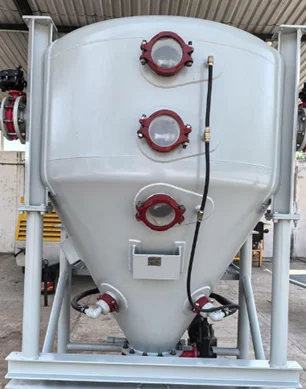
Nordstone is a premier choice among industrial surge drum manufacturers in the United Arab Emirates, delivering custom-engineered pressure vessels designed to withstand the region’s harshest operating conditions. With over 20 years of manufacturing experience, our team specializes in designing high-performance surge drums that provide vital liquid-vapor separation, pressure regulation, and surge protection for critical pipelines and processing facilities. From our state-of-the-art facility, we build heavy-duty vessels engineered to handle extreme temperatures, high pressures, and highly corrosive environments. Every surge drum we manufacture adheres strictly to global standards, backed by our international API, ASME, and ISO certifications, ensuring absolute reliability and safety for your operations. Whether you are managing complex upstream fluids in Abu Dhabi or large-scale downstream refining infrastructure in Ruwais, Nordstone provides the precision engineering your facility demands.
Ready to discuss your project specifications? Contact our engineering team today to get a detailed technical consultation and quote.
Frequently Asked Questions
1. What is a surge drum, and how does it function in industrial systems?
A surge drum (or surge vessel) is a specialized pressure vessel designed to absorb sudden fluctuations in liquid flow or pressure within a processing system. It acts as a temporary holding buffer, stabilizing the downstream flow of fluids and preventing hazardous pressure spikes or equipment starvation.
2. Why are Nordstone surge drums suited for the UAE’s specific climate and operating conditions?
Operating in the UAE means dealing with extreme ambient temperatures, high humidity, and coastal salinity. Nordstone utilizes advanced metallurgical selections, heavy-duty corrosion allowances, and high-performance external coatings specifically engineered to resist thermal stress and ambient atmospheric corrosion.
3. Which manufacturing and engineering standards do your surge drums follow?
Our manufacturing processes align with the highest global benchmarks. We design and fabricate surge drums according to ASME Section VIII (Div 1 & 2), API 650/620, and international ISO quality management guidelines to guarantee legal compliance and structural integrity in high-risk zones.
4. What industries in the UAE do you serve with your surge vessels?
We provide custom processing solutions across a wide range of critical sectors, including:
- Oil & Gas (Upstream exploration and downstream refining)
- Petrochemical and Chemical Processing
- Power Generation and Water Desalination plants
- Defence and Industrial Infrastructure
5. Can Nordstone manufacture surge drums tailored to specific dimensions and pressures?
Yes. We specialize entirely in custom-engineered solutions. Our engineering team designs each vessel from scratch to match your specific flow rates, holding capacities, design pressures, chemical compositions, and physical spatial constraints.
6. What types of materials do you use to manufacture surge drums?
Depending on your fluid characteristics, we construct vessels using high-strength carbon steel, low-temperature carbon steel (LTCS), austenitic or duplex stainless steel, and specialized corrosion-resistant alloys (CRA) or internal claddings to prevent sour gas degradation (H2S).
7. What is the typical lead time for manufacturing a surge drum in the UAE?
Lead times vary depending on the vessel size, material availability (such as specialized alloy plates), and design complexity. Generally, custom fabrications take anywhere from 12 to 24 weeks, including engineering approvals, procurement, welding, and rigorous testing phases.
8. Do your surge vessels undergo non-destructive testing (NDT)?
Absolutely. To meet ASME and API benchmarks, we execute thorough NDT protocols. This includes 100% radiography (RT) on critical weld joints, ultrasonic testing (UT), magnetic particle testing (MT), dye penetrant testing (PT), and final hydrostatic pressure testing.
9. How does a surge drum differ from a standard storage vessel?
While a storage vessel is designed to hold large volumes of product long-term under steady conditions, a surge drum is dynamically engineered to handle continuous, erratic changes in fluid volume, pressure, and multi-phase separation on a minute-by-minute basis.
10. Can you integrate internal components into the surge drum design?
Yes. Depending on your operational requirements, we integrate customized internals such as mist eliminators, inlet deflector plates, vortex breakers, calming baffles, and multi-stage separation packs to optimize fluid behavior and prevent liquid carryover.
11. Do you provide localized support and site inspections within the UAE?
Yes, our engineering presence in the region allows us to offer swift on-site technical consultations, dimensions verification, manufacturing progress inspections, and delivery coordination directly to your site or facility across all seven emirates.
12. How does Nordstone ensure the safety and relief systems of its surge drums?
Every drum is designed with precise nozzle allocations for pressure safety valves (PSVs), rupture discs, continuous level transmitters, and low/high-level alarms. This ensures the vessel can safely vent or isolate during a critical overpressure event.
13. Is internal coating or cladding available for corrosive sour gas services?
Yes. For facilities handling corrosive media or high sour gas contents, we provide specialized internal epoxy coatings, rubber linings, or metallurgical weld overlay claddings (such as Inconel) to completely isolate the structural steel from corrosive attack.
14. What documentation do you provide upon delivery of the equipment?
We deliver a comprehensive Manufacturer’s Data Report (MDR). This includes ASME partial data reports, material test certificates (MTCs), approved welding procedure specifications (WPS), NDT test records, hydro-test charts, and official third-party inspection certifications.
15. How do I initiate a request for quotation (RFQ) with Nordstone?
To get started, you can share your process design data sheet—including operating/design pressure and temperature, fluid medium, required surge volume, and nozzle configurations—by visiting our contact page to connect directly with an applications engineer.