As a leading name among separator vessel manufacturers in UAE, Nordstone delivers high-performance processing equipment engineered specifically for the region’s demanding oil, gas, and industrial sectors. With over 20 years of experience in precision engineering and heavy fabrication, we specialize in designing and manufacturing custom multi-phase separators that effectively split well fluids into oil, gas, and water streams. Our state-of-the-art manufacturing facility utilizes advanced automated welding and cutting technologies to build rugged, reliable processing vessels capable of enduring the extreme pressures, elevated temperatures, and highly corrosive environments typical of Middle Eastern fields.
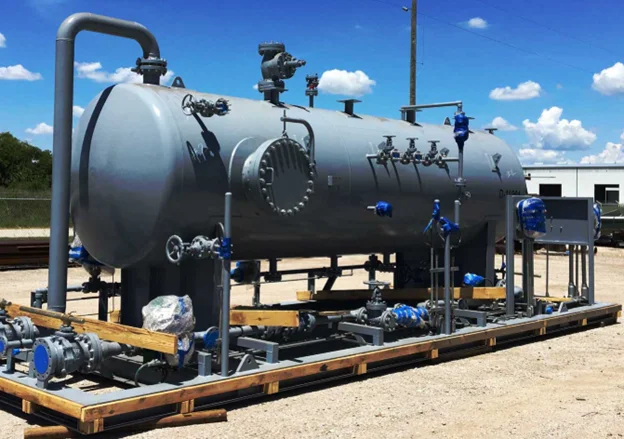
Every custom separator vessel we produce strictly adheres to international safety and engineering protocols, holding prestigious API, ASME, and ISO certifications. From initial design and stress analysis to rigorous non-destructive testing (NDT), our expert engineering team ensures meticulous quality control at every phase of production. Whether you require standard production separators, test separators, or advanced scrubbing units, Nordstone provides local, world-class manufacturing compliance that minimizes lead times and optimizes your upstream, midstream, or downstream operations.
Frequently Asked Questions
1. What types of separator vessels does Nordstone manufacture in the UAE?
We design and manufacture a comprehensive range of industrial separator vessels, including horizontal and vertical configurations for two-phase (liquid-gas) and three-phase (oil, gas, and water) separation. Our portfolio includes production separators, test separators, slug catchers, knock-out drums, and gas scrubbers tailored to specific operating flow rates and pressures.
2. Which international manufacturing standards do your vessels comply with?
Our engineering and manufacturing processes are strictly certified to international standards. We hold authorizations for ASME (Section VIII, Division 1 & 2) for pressure vessels, alongside API (American Petroleum Institute) and ISO quality management standards. This ensures total compliance with both local UAE regulations and global energy sector requirements.
3. How does Nordstone ensure vessels withstand the corrosive environments of the UAE?
We utilize high-grade, corrosion-resistant materials such as sour-service carbon steel, stainless steel alloys, duplex, and super duplex stainless steels. Additionally, we apply specialized internal corrosion-resistant overlays (cladding) and heavy-duty external coatings engineered specifically to survive harsh desert, marine, and high-salinity coastal environments.
4. Can you customize separator vessels for specific pressure and temperature thresholds?
Yes. Backed by 20 years of experience, our internal engineering team uses advanced finite element analysis (FEA) and thermal design software to custom-engineer vessels capable of safely handling extreme high-pressure (HP) and high-temperature (HT) applications, matching your exact field specifications.
5. What internal components are integrated into your separator vessels?
To achieve high separation efficiency, we integrate advanced internals based on your process data. These include inlet deflector devices, cyclonic inlets, straightening vanes, coalescing plates, wire-mesh mist extractors, and vane-type demisters to minimize liquid carry-over and gas carry-under.
6. Do you cater to industries outside of Oil & Gas in the region?
While the oil and gas sector is a primary market, our certified pressure vessels are widely utilized across other critical applications in the UAE, including the Defence sector, petrochemical processing plants, heavy industrial manufacturing, and large-scale water treatment facilities.
7. What quality control and testing procedures do you follow?
We implement rigorous quality control from raw material receipt to final dispatch. Testing procedures include comprehensive Non-Destructive Testing (NDT) such as Radiographic Testing (RT), Ultrasonic Testing (UT), Magnetic Particle Testing (MT), and liquid penetrant inspection, culminating in a mandatory hydrostatic pressure test witnessed by internal and third-party inspectors.
8. Are your separator vessels suitable for sour service (H2S environments)?
Yes. We specialize in manufacturing vessels for sour service applications in full compliance with NACE MR0175 / ISO 15156 standards. This involves using HIC (Hydrogen-Induced Cracking) resistant steels and specialized post-weld heat treatment (PWHT) to prevent sulfide stress cracking.
9. What are the advantages of choosing a local UAE separator manufacturer over importing?
Choosing a local manufacturer like Nordstone significantly reduces transport lead times, eliminates complex import logistics, and offers direct access to fast-response field support. It also aligns with local procurement goals and ensures the equipment is purpose-built for regional ambient conditions.
10. Does Nordstone offer skid-mounted separator packages?
Yes, we provide fully integrated, turn-key skid-mounted separator modules. These packages include the separator vessel, process piping, structural steel skid, instrumentation, control valves, and electrical wiring, completely assembled and tested at our facility for rapid plug-and-play installation on-site.
11. What details are required to get an accurate manufacturing quotation?
To provide a precise technical proposal, we require your process design package, which includes operating and design pressures/temperatures, fluid composition (oil, gas, water ratios), flow rates, fluid properties (density, viscosity), presence of $H_2S$ or $CO_2$, and preferred code standards.
12. How does Nordstone manage post-weld heat treatment (PWHT) for thick-walled vessels?
Our state-of-the-art facility is equipped with automated, calibrated heat-treatment furnaces. PWHT is performed strictly according to ASME code requirements to relieve residual stresses induced during rolling and welding, ensuring structural integrity and long-term fatigue resistance.
13. Can your engineering team work with third-party inspection agencies (TPI)?
Absolutely. We regularly collaborate with globally recognized third-party inspection agencies such as Bureau Veritas, TÜV, Lloyd’s Register, and DNV. We accommodate client-specified inspection and test plans (ITP) with designated hold and witness points throughout fabrication.
14. What documentation is provided upon delivery of the vessel?
Every vessel is handed over with a comprehensive Manufacturer’s Data Report (MDR). This technical dossier includes ASME code stamping forms, material test certificates (MTCs), welding log books (WPS/PQR), NDT reports, heat treatment charts, hydrostatic test certificates, and final inspection releases.
15. How can we initiate a project discussion or request a facility audit?
You can easily coordinate a technical consultation or schedule a plant visit to audit our manufacturing capabilities. Simply visit our technical team directly through our dedicated contact page to share your project specifications: