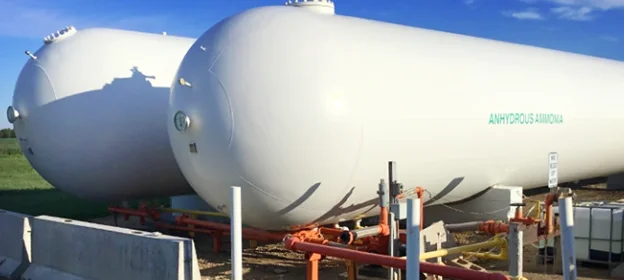
With over 20 years of expertise, Nordstone stands as a premier choice among Ammonia Storage Vessel manufacturers in UAE, engineering high-performance pressure vessels designed specifically for the region’s demanding conditions. Storing anhydrous or aqueous ammonia presents unique engineering challenges, primarily due to its toxicity, high vapor pressure, and susceptibility to Stress Corrosion Cracking (SCC).
To eliminate these risks, our custom-engineered ammonia storage vessels are fabricated utilizing specialized carbon-manganese steel featuring optimized yield strength and undergo rigorous Post-Weld Heat Treatment (PWHT). Built strictly in accordance with ASME Section VIII Division 1 & 2 and API 620 codes, our facilities in the UAE produce pressurized and refrigerated storage systems capable of withstanding extreme thermal environments, corrosive conditions, and high operating pressures.
Our engineering team integrates state-of-the-art safety systems—including advanced leak detection, dual pressure relief valves, and robust secondary containment systems—ensuring total compliance with local civil defense and international environmental mandates. From initial design and 100% radiographic inspection to final hydro-testing, Nordstone delivers unmatched reliability and precision, protecting your workforce, your plant, and your bottom line.
Frequently Asked Questions
1. What design codes govern ammonia storage vessel manufacturing in the UAE?
Ammonia storage vessels are manufactured under strict international engineering standards. The most widely accepted codes are ASME Section VIII Division 1 or Division 2 for pressurized vessels, and API 620 (specifically Annex R) for large, low-pressure, refrigerated atmospheric storage tanks.
2. Why is material selection critical for ammonia storage?
Ammonia induces Stress Corrosion Cracking (SCC) in high-yield steels, especially when oxygen contamination is present. Nordstone utilizes fine-grain carbon-manganese steel (such as P355NL2 or SA-516 Grade 70) with low yield strengths and controlled chemistry to minimize crack propagation while maintaining low-temperature toughness.
3. What is Post-Weld Heat Treatment (PWHT) and why is it mandatory?
PWHT involves heating the completed vessel structure to a specific temperature and cooling it slowly. This process relieves residual mechanical stresses introduced during rolling and welding. For ammonia service, PWHT is the primary defense against stress corrosion cracking, ensuring the structural integrity of weld seams.
4. What materials are strictly prohibited in ammonia storage systems?
Copper, zinc, brass, bronze, and galvanized materials are completely incompatible with ammonia. When exposed to moisture and ammonia, these materials rapidly corrode and degrade, which can lead to catastrophic seal, structural, or instrument component failure.
5. What are the two main types of industrial ammonia storage?
- Pressurized Storage: Holds anhydrous ammonia at ambient temperatures under high pressures (typically 150 to 250 psi), usually in smaller bullet tanks.
- Refrigerated Storage: Keeps bulk ammonia liquefied at low temperatures around -33°C (-28°F) at or near atmospheric pressure.
6. How does Nordstone manage extreme UAE temperatures for ambient pressurized tanks?
High ambient temperatures in the UAE increase the internal vapor pressure of ammonia. We design vessels with higher maximum allowable working pressures (MAWP), apply highly reflective, corrosion-resistant UV coatings, and can integrate external insulation or cooling jackets to control thermal gains.
7. What testing and inspection protocols are conducted during fabrication?
Every vessel undergoes comprehensive, multi-stage non-destructive testing (NDT). This includes 100% radiography (RT) on all main pressure-retaining weld joints, ultrasonic testing (UT), magnetic particle inspection (MPI) for surface cracks, and a final hydrostatic pressure test.
8. Which industries in the UAE require industrial ammonia vessels?
Ammonia storage is critical for fertilizer and petrochemical complexes, industrial refrigeration plants, large-scale chemical processing operations, and power generation units utilizing Selective Catalytic Reduction (SCR) systems for emissions control.
9. What safety relief systems are integrated into your vessels?
Due to the toxicity of ammonia, vessels are equipped with redundant safety valves, typically configured with a three-way manifold allowing inspection without system shutdown. Relief valves are routed to a safe height vent stack or an automated scrubber system rather than venting directly to the atmosphere.
10. Does Nordstone manufacture secondary containment structures?
Yes. Regulatory bodies in the UAE require strict spill and vapor mitigation. We engineer double-wall steel vessel configurations or provide consulting on concrete bund walls designed to contain 110% of the vessel’s volume in the event of an emergency.
11. What sealing and gasket materials are safe for ammonia service?
Standard nitrile elastomers fail rapidly in ammonia systems. We exclusively use compatible sealing elements such as PTFE (Teflon), EPDM, or specialized graphite-filled gaskets that preserve tight seals under extreme temperature cycling and chemically aggressive environments.
12. Are your manufacturing facilities and welders certified?
Yes. Our facility maintains valid ASME (U, U2 stamps), API, and ISO certifications. Furthermore, all our welding procedures (WPS) and welding operators are fully qualified to ASME Section IX requirements specifically for low-temperature pressure vessel fabrication.
13. What is the typical storage lifespan of a Nordstone ammonia vessel?
With proper maintenance, regular API 510 fitness-for-service inspections, and adherence to operation parameters, our heavy-duty industrial vessels are engineered for an operational lifespan exceeding 20 to 30 years.
14. Can you manufacture custom nozzle arrangements and dimensions?
Absolutely. Every vessel is custom-built. Our team design-engineers nozzle placements, process instrument connections, manways, and internal siphon or piping configurations exactly to your plant layout and process flow requirements.
15. How do I initiate a project quote or design consultation with your engineering team?
You can get in touch with our UAE technical sales office directly by visiting our Contact Us page to share your design pressure, required volume capacity, and operating temperature specifications.